Apple’s Next CEO Inherits an AI Credibility Gap, Not Just a Product Roadmap
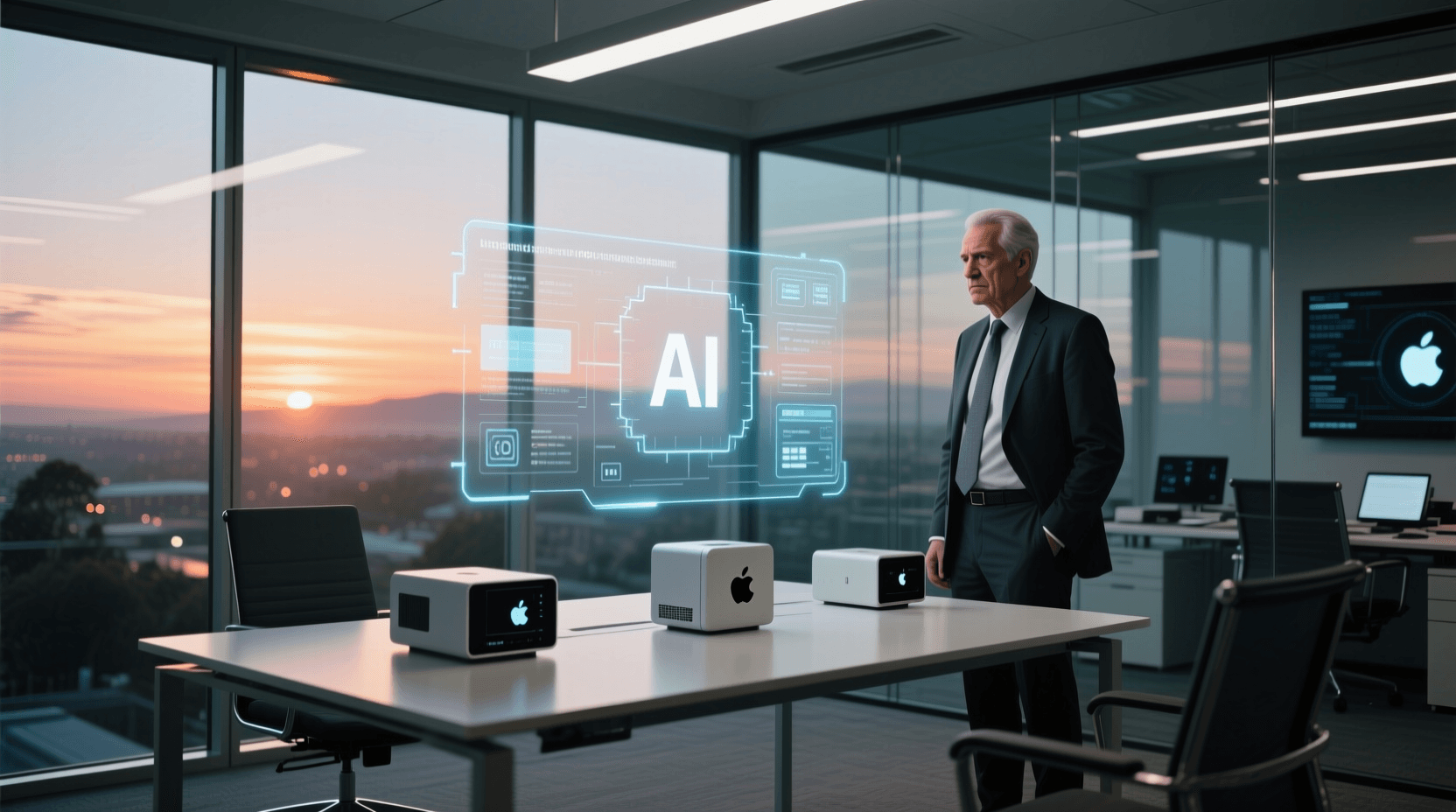
Apple’s leadership transition matters for more than succession-watchers and Wall Street. It matters because the company is entering an era where AI is no longer a side capability, a demo category, or a branding exercise. It is becoming the operating layer for software, devices, services, and even business operations.
That means John Ternus is not just inheriting a product portfolio. He is inheriting an AI credibility gap.
The real challenge is trust, not timing
A lot of commentary around big tech and AI focuses on who shipped first, who announced the flashiest model, or who had the loudest keynote. But for Apple, the bigger issue is different: users and developers need to believe the company knows what role AI should play across its ecosystem.
Apple has historically won by making immature technologies feel inevitable. It rarely needed to be first. It needed to make the market feel finished. The problem with AI is that the market is moving too fast for that old rhythm. Waiting until everything is polished can look less like discipline and more like hesitation.
For AI tool users, this matters because platform confidence shapes workflow decisions. If Apple looks uncertain, developers will build around it rather than through it. That means more energy flowing into browser-based AI, cross-platform agents, and independent APIs instead of deeply native Apple experiences.
Hardware-first leadership could be an advantage — if Apple changes its AI framing
There is an easy narrative that a hardware executive taking over means Apple will lag further in AI. I think that is too simplistic.
In fact, a hardware-centric CEO could push Apple toward a more defensible AI strategy: practical intelligence embedded into devices people already trust. Not AI as spectacle, but AI as invisible utility. Battery-aware assistants. Contextual automation. On-device inference that actually respects privacy. Personal workflows that span phone, laptop, watch, earbuds, and car without feeling stitched together.
That is a real opportunity. But it only works if Apple stops treating AI like a feature bucket and starts treating it like a systems layer.
Developers already understand this shift. The winning products are increasingly the ones that combine models, memory, workflow orchestration, and distribution. Users do not care whether a task is completed by a chatbot, an embedded model, or an autonomous agent. They care whether the job gets done reliably.
That is why tools like SureThing.io are worth watching. The appeal is not novelty; it is operational stability. The market is moving from “show me an AI trick” to “run this process without breaking anything.” If Apple wants to matter in the next AI phase, it has to compete on dependable execution, not just elegant interfaces.
The next platform war is about orchestration
The most important AI battleground may not be the model itself. It may be who controls the orchestration layer between user intent, apps, data, and action.
That is where Apple faces pressure. If users increasingly rely on AI systems that sit above the app layer, then the company’s traditional ecosystem leverage weakens. The assistant becomes the interface. The workflow engine becomes the operating system. The app becomes a modular service endpoint.
This is a profound shift for every platform owner.
If Apple cannot define how AI agents interact with its ecosystem, someone else will. Browser companies, API providers, enterprise AI vendors, and independent agent platforms are all racing toward that role. For developers, this creates an opening: build tools that are portable, composable, and not dependent on a single platform’s AI timeline.
For founders and product teams trying to track where this is heading, signal quality matters. Hype moves faster than reality in AI, and leadership transitions amplify speculation. That is why curated sources like Tech Twitter are useful: they compress the daily noise around AI, startups, and product development into something actionable. And if you want a broader pulse on what is rising quickly across the ecosystem, AI Tech Viral helps surface the technologies and themes gaining momentum before they become consensus.
Apple’s AI test will be cultural before it is technical
The hardest part of this transition may be internal. Apple is excellent at secrecy, control, and tightly integrated releases. Modern AI development rewards a different operating model: faster iteration, more visible experimentation, and a higher tolerance for imperfection.
That does not mean Apple should imitate every lab or startup. But it does mean the company needs to show developers a clearer theory of participation. What should third parties build? Where should they plug in? What capabilities will be native, and which will remain external?
If those answers remain fuzzy, developers will default to platform-agnostic strategies. That is rational. No one wants to wait for a giant company to decide whether AI is central or cosmetic.
What AI builders should take away
The lesson here is not “bet against Apple.” It is “do not wait for platform giants to validate your roadmap.”
AI builders should assume a more fragmented future, where users move fluidly between native experiences, web apps, agentic tools, and specialized services. Build for interoperability. Build for reliability. Build for the moment when the assistant, not the app icon, becomes the entry point.
John Ternus may ultimately be the right leader for Apple’s AI era. A hardware veteran could help the company turn AI into something more durable than a chatbot race. But he will need to prove that Apple can still define the next interface shift rather than merely absorb it.
That is his first big AI problem: not catching up on features, but convincing the market that Apple still knows how to lead when computing changes shape.