Enterprise AI’s Real Bottleneck Isn’t the Model — It’s the Agent Layer
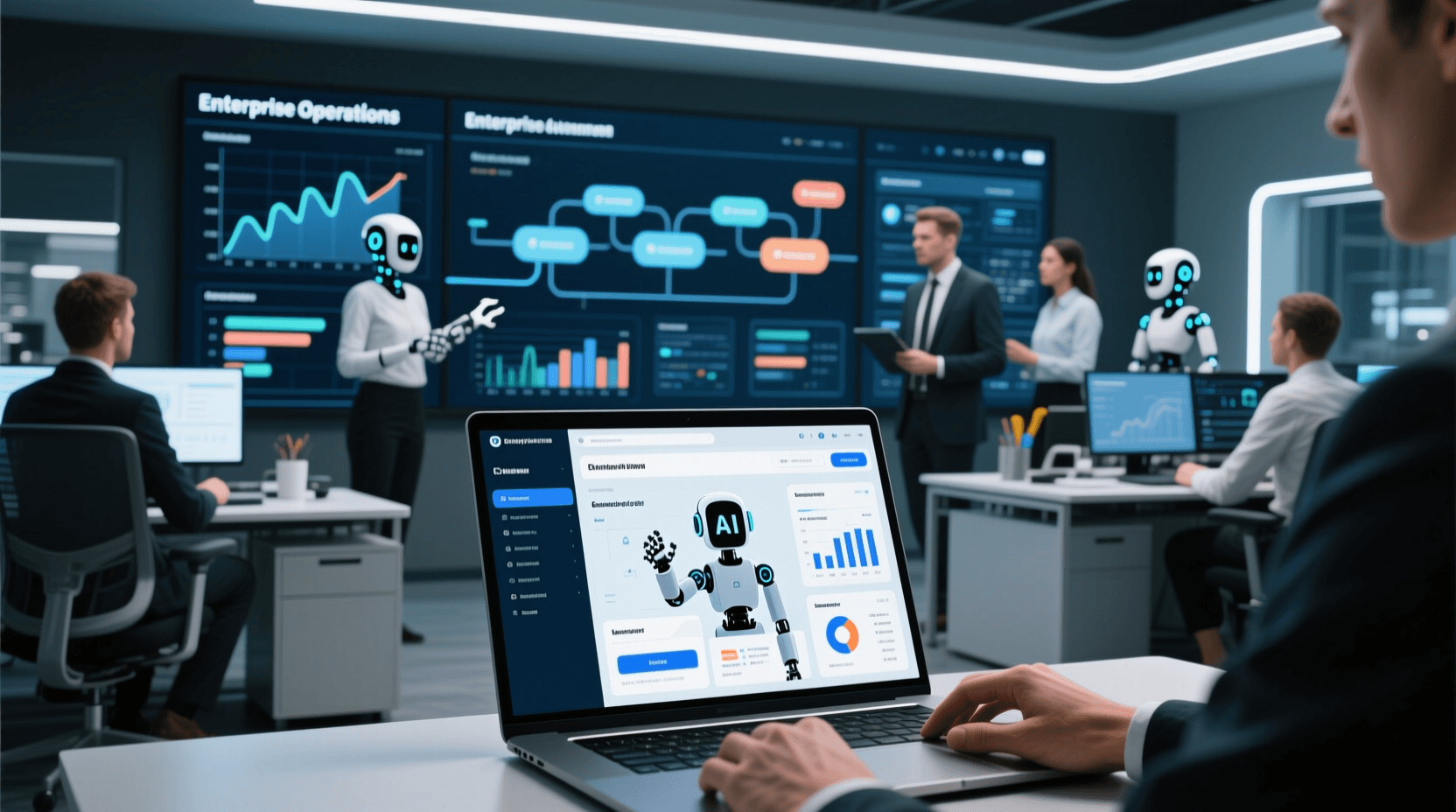
Large language models have reached the point where most enterprises no longer ask, “Can the model generate useful output?” The harder question is now, “Can we trust an AI system to do useful work repeatedly, safely, and at scale?” That shift matters. It means the next phase of enterprise AI adoption will be decided less by model benchmarks and more by agent logic: the orchestration, memory, tool use, safeguards, and decision policies that turn a clever model into a dependable worker.
Why the model race is no longer the whole story
For the past two years, AI strategy has often been framed as a model selection problem. Teams compared context windows, token pricing, reasoning performance, and latency. Those factors still matter, but they are increasingly becoming procurement variables rather than strategic differentiation.
In practice, many enterprise deployments fail for reasons that have little to do with raw model intelligence. The system breaks because it calls the wrong tool, loops on a task, loses state between steps, mishandles edge cases, or cannot recover when a website changes its layout. A model may write a brilliant answer in a demo, yet still be useless in production if the surrounding agent logic is brittle.
That’s why enterprise buyers are beginning to think in terms of operational reliability rather than pure model capability. They want systems that can decide when to ask for clarification, when to escalate to a human, when to stop, and how to document what happened. Those are agent design questions.
Agent logic is where business value becomes real
An LLM alone is mostly a prediction engine. An enterprise agent is a workflow engine with judgment constraints. The difference is enormous.
If a company wants AI to reconcile invoices, monitor competitors, update CRM records, or triage support tickets, success depends on how the system sequences actions across multiple tools and environments. It needs planning, retries, permissions, memory, and observability. It needs a policy layer that defines what is allowed, what is risky, and what requires approval.
This is where a lot of current AI excitement meets enterprise reality. Businesses do not just need “smart” outputs. They need accountable systems that can operate inside messy, permissioned, changing environments. The firms that understand this early will stop chasing the newest model every quarter and start investing in reusable agent infrastructure.
Web interaction is the hidden stress test
One of the clearest examples of agent logic becoming essential is browser-based automation. Many high-value enterprise tasks still live in web interfaces: procurement portals, internal dashboards, partner systems, legacy admin panels, and public websites with anti-bot protections. This is exactly where a simple API-first view of AI breaks down.
For AI agents to work reliably on the web, they need more than language understanding. They need robust navigation, session handling, form interaction, and resilience against CAPTCHAs, fingerprinting, and dynamic page changes. Tools like LLM Browser and LLM Browser point to an important trend: the browser itself is becoming part of the AI stack, not just a user interface. If agents are going to perform real-world tasks online, stealth access and stable automation are not fringe features. They are prerequisites.
That has major implications for developers. Building agentic systems increasingly means thinking like both an ML engineer and an infrastructure engineer. You are no longer just prompting a model. You are managing execution environments where failure can happen at every layer.
The future belongs to systems that can improve themselves
Another reason agent logic matters is that enterprise environments are never static. Workflows change. Compliance rules shift. Interfaces get redesigned. New tools get added. A rigid AI pipeline degrades quickly.
This is why self-improving and modular agent ecosystems are so compelling. Projects like EvoAgentX reflect a broader move toward agents that can evolve, coordinate, and adapt rather than simply execute a fixed script. That matters because scalable enterprise AI cannot depend on constant manual rewiring by a small specialist team. Organizations need agent frameworks that can absorb change without becoming operationally fragile.
The long-term winners in enterprise AI may not be the companies with access to the single most powerful model. They may be the ones with the best architecture for continuous adaptation: evaluation loops, modular toolchains, agent collaboration, and governance built into the workflow.
What AI tool users should demand next
For buyers and operators, this shift changes what “good AI” looks like. Instead of asking only about model quality, they should ask:
- How does the agent decide its next action?
- What happens when a tool fails or returns ambiguous data?
- Can humans inspect the chain of decisions?
- How are permissions and guardrails enforced?
- How quickly can the system adapt when the environment changes?
These questions are less flashy than leaderboard scores, but they are much closer to ROI.
The next AI platform battle is below the surface
The industry is moving beyond the era where model access alone creates defensibility. As foundation models become more available and interchangeable, value is shifting downward into orchestration and upward into outcomes. The agent layer is where those two forces meet.
For enterprises, that means scalable AI adoption will depend on building systems that can act, recover, explain themselves, and improve over time. For developers, it means the real craft is no longer just prompt engineering. It is designing the logic that makes AI dependable in the wild.
That may be less glamorous than announcing a bigger model. But it is far more likely to determine who actually captures value from AI over the next five years.