Human-in-the-Loop AI Is Becoming the Real Product Strategy
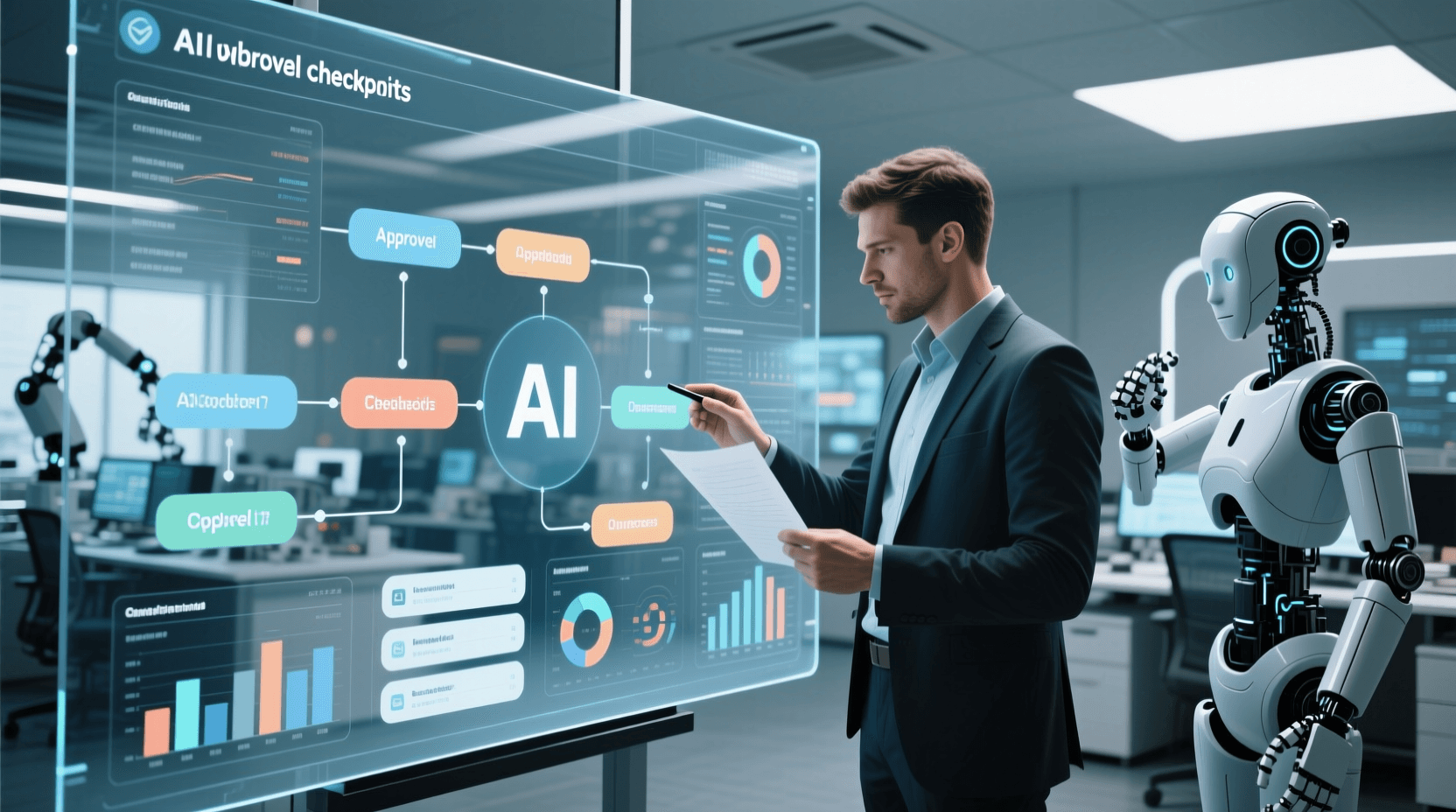
AI companies have spent the last two years selling a future of total automation. The pitch has been simple: hand more work to models, reduce human effort, and scale output faster than any team could alone. But a more durable strategy is starting to emerge—one that treats AI not as a replacement for people, but as infrastructure for better human judgment.
That shift matters. If the next wave of AI products is built around collaboration instead of substitution, it will change how startups design tools, how enterprises buy them, and how workers decide which platforms to trust.
The market is moving from autonomy to accountability
The first generation of mainstream AI products won attention by showing what models could do on their own. They could draft, code, classify, summarize, and generate. But once these systems moved from demos into real workflows, a harder question appeared: who is responsible when the AI is wrong?
That question is reshaping product design. In regulated industries, customer support, software deployment, finance, healthcare, and internal operations, fully autonomous systems often create more risk than value. A model that acts independently may save minutes, but one mistake can cost a company trust, money, or compliance standing.
Human-in-the-loop design is therefore not a philosophical compromise. It is increasingly a commercial advantage. Buyers want systems that accelerate decisions without obscuring who approved them. They want audit trails, editable outputs, escalation paths, and review checkpoints. In other words, they want AI that behaves more like a highly capable collaborator than an unsupervised employee.
This is one reason platforms like OpenAI remain central to the ecosystem. The value is no longer just raw model intelligence. It is the ability to build layered systems around that intelligence—systems where prompting, retrieval, tool use, and human review all work together in a controlled loop.
Collaboration is harder to build than automation
There is a misconception that keeping humans involved is the "easy" path. In reality, collaborative AI is often more difficult to design than fully automated AI.
Automation is a clean story: input goes in, output comes out, task completed. Collaboration is messier. It requires products to understand when to ask for clarification, when to defer, when to explain confidence, and when to stop. It requires interfaces that make review fast instead of burdensome. It requires orchestration logic that routes work to the right human at the right time.
That is where a lot of the next product differentiation will happen. The winners may not be the companies with the most dramatic autonomy claims, but the ones that make human oversight feel natural and efficient.
For builders, this creates a huge opportunity. Tools like Activepieces are especially relevant in this environment because they let teams create practical automations with approval steps, branching logic, and integrations across business systems. That is what real-world AI adoption looks like for many organizations: not replacing the workflow, but inserting intelligence into it.
The no-code and low-code layer becomes even more important when companies need to customize where human review happens. A marketing team may want AI to generate campaign variants but require manager approval before publishing. A sales team may let AI draft outbound sequences but keep account executives responsible for final messaging. A finance team may use AI to flag anomalies but never authorize payments without human signoff.
The trust economy will define AI adoption
The next phase of AI competition is not just about capability. It is about trust architecture.
Users do not simply ask whether a model is smart. They ask whether it is predictable, steerable, and governable. Can they inspect its reasoning process, even partially? Can they limit its permissions? Can they intervene mid-task? Can they learn from its mistakes and tune the system over time?
This is especially important for developers building products on top of foundation models. If your app promises full automation and then fails unpredictably, customers will churn quickly. If your app promises assisted intelligence with clear controls, customers are more likely to experiment, expand usage, and integrate it into core operations.
That should influence startup strategy right now. Founders looking for opportunities should stop thinking only in terms of "what jobs can AI do alone?" and start asking, "where does AI make human expertise dramatically more productive?" That framing opens better categories: review copilots, decision support systems, agent supervisors, workflow triage tools, and domain-specific assistants.
If you are exploring those product ideas, Startup AIdeas is a useful resource because it pushes founders to think beyond generic chatbot concepts and toward more defensible AI ventures. The strongest startups in this cycle may be the ones that design around human leverage rather than human removal.
What this means for AI users and developers
For users, the message is encouraging: you do not need to choose between ignoring AI and surrendering your work to it. The most valuable tools will likely be the ones that let you stay in control while removing repetitive effort.
For developers, the message is more demanding: building useful AI is no longer just about model access. It is about workflow design, permissioning, observability, and user confidence. The interface around the model is becoming as important as the model itself.
That is a healthier direction for the industry. AI does not need to automate every human task to be transformative. In many cases, its biggest impact will come from making people faster, sharper, and more scalable without erasing their role in the process.
The companies that understand that distinction will build products that last.