Military AI Is Entering Its Operator Era—and Civilian Builders Should Pay Attention
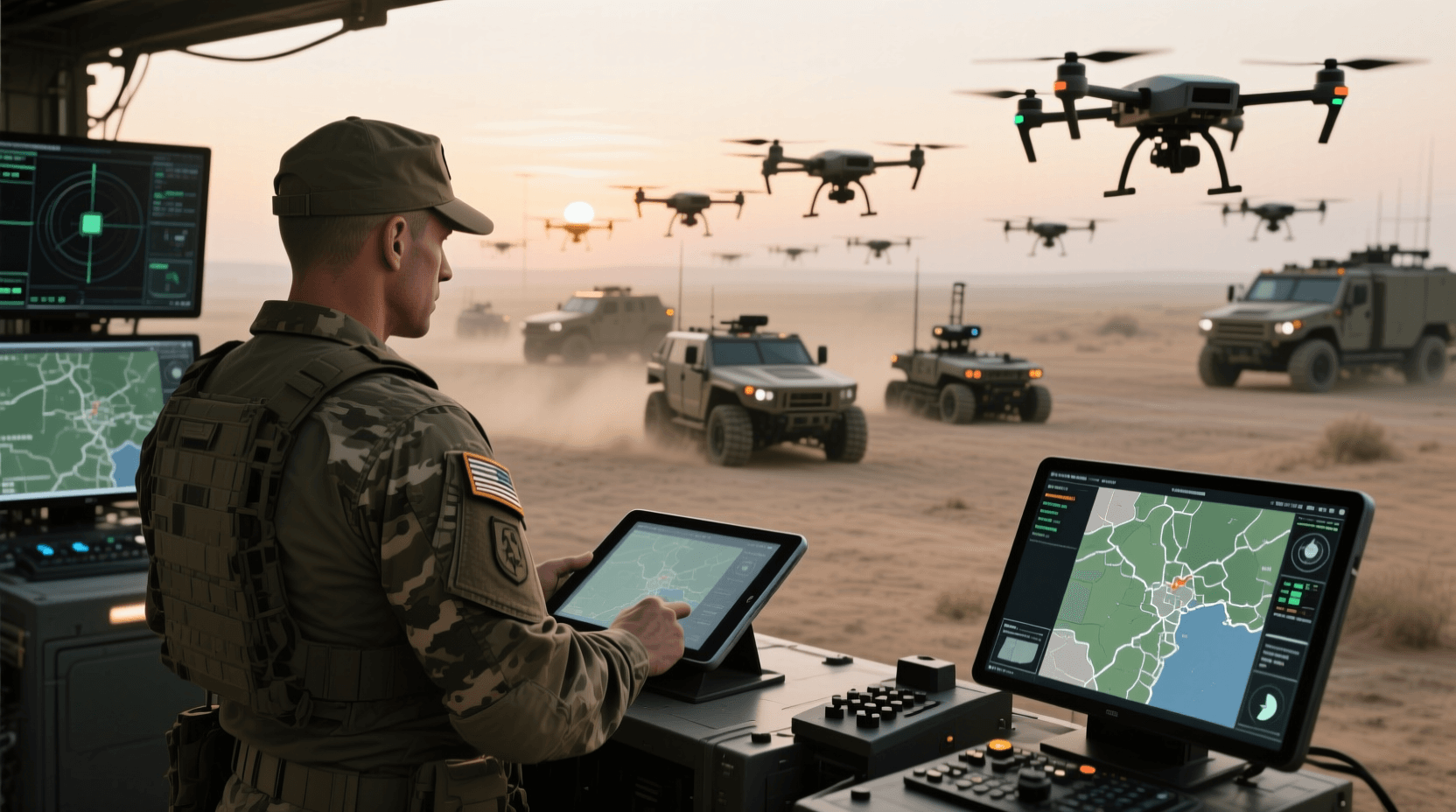
The next major shift in AI may not come from a chatbot, a design copilot, or a coding assistant. It may come from the battlefield’s demand for systems that can coordinate machines under pressure, with incomplete information, unreliable connectivity, and real-world consequences.
That is why the latest wave of defense-focused AI investment matters far beyond military procurement. When startups build AI agents that help a single human direct swarms of autonomous systems, they are stress-testing a future that many commercial software teams are also racing toward: one person managing fleets of intelligent tools.
From single assistants to machine teams
For the last two years, mainstream AI has been framed around the individual user prompt. Ask a model a question, get an answer. Generate an image, summarize a document, draft an email. Useful, yes—but still largely transactional.
What’s emerging now is something more operational. AI is becoming less like a clever assistant and more like a mission coordinator. In defense settings, that means managing drones, sensors, vehicles, and changing objectives. In enterprise settings, it means orchestrating research agents, analytics agents, outreach agents, and workflow automations across departments.
The important pattern is not the military branding. It is the architecture: human intent at the top, multiple semi-autonomous systems underneath, and an AI layer translating goals into coordinated action.
That same pattern is already visible in commercial platforms. Teams using OpenAI are increasingly experimenting with agentic workflows that can reason across tools, maintain context, and complete multi-step tasks. The military use case simply forces this model to mature faster because failure is less forgiving.
The real product is trust under uncertainty
A lot of AI demos look impressive in controlled environments. Very few survive contact with ambiguity. Defense AI, by necessity, is being built for noisy data, adversarial conditions, shifting constraints, and patchy communications. That makes it a useful lens for evaluating the next generation of AI products more broadly.
For AI tool users, the lesson is straightforward: raw model intelligence is no longer enough. The winning systems will be the ones that remain usable when the environment becomes messy.
In practical terms, that means developers should care more about:
- fallback behavior when models are uncertain
- explainability at the decision layer
- robust human override controls
- degraded-mode performance when APIs or sensors fail
- clear role boundaries between recommendation and execution
These are not just defense requirements. They are exactly the issues that determine whether AI becomes dependable in logistics, healthcare operations, finance, cybersecurity, and customer support.
Why this changes the AI tool market
The AI market is often discussed as a race for bigger models. But this moment suggests a different battleground: operational systems design.
The startups that matter most over the next five years may not be the ones with the flashiest foundation model. They may be the ones that can turn models into coordinated, auditable, high-stakes decision systems.
That is one reason the broader acceleration tracked by Super AI Boom is so significant. The story is no longer just about smarter outputs. It is about AI becoming embedded in command structures, execution layers, and machine-to-machine coordination. Once that shift happens, the value moves up the stack—from model novelty to system reliability.
For enterprise buyers, this should sharpen procurement questions. Don’t just ask whether an AI tool can perform a task. Ask whether it can manage a chain of tasks, communicate confidence, recover from failure, and keep a human meaningfully in control.
Dual-use innovation is becoming the default
There is also an uncomfortable but important reality here: many of the most powerful AI capabilities are inherently dual-use. Navigation, planning, autonomy, sensor fusion, simulation, and fleet coordination all have civilian and military applications.
That means developers can no longer pretend that “AI ethics” is a side conversation handled by policy teams after launch. If your product helps coordinate autonomous action at scale, governance is part of product design.
This creates a new competitive advantage for companies that can pair technical capability with strategic intelligence. Tools like BrandScout become more relevant in this environment because market leaders need more than feature comparisons—they need visibility into where competitors, regulators, and adjacent industries are moving. In a dual-use AI economy, strategic blind spots can become existential risks.
What builders should do next
If you build AI products, this moment should push you to think less like an app developer and more like a systems operator.
That means:
- Design for supervision, not just automation.
- Build interfaces for managing many agents at once.
- Treat reliability as a product feature, not an infrastructure concern.
- Make model uncertainty visible to users.
- Plan now for policy scrutiny, especially if your tools can direct physical systems.
The defense sector may be an extreme environment, but that is exactly why it offers a preview of where AI is heading. High-stakes users are demanding systems that can convert one person’s intent into coordinated action across many machines. Commercial users will soon want the same thing—just in warehouses, hospitals, call centers, supply chains, and field operations instead of combat zones.
The bigger takeaway
The most important AI interface of the next decade may not be a chat window. It may be a control layer.
Whoever builds the best control layers—clear, trusted, resilient, and scalable—will shape how humans work with fleets of AI systems in every industry. Today that future is being tested in defense. Tomorrow it will define mainstream software.
For AI users and developers alike, the signal is clear: the age of isolated assistants is ending. The age of AI-directed operations has begun.