The Real Reason Medical Offices Don’t Call Back—and Why AI Is Becoming the Front Desk
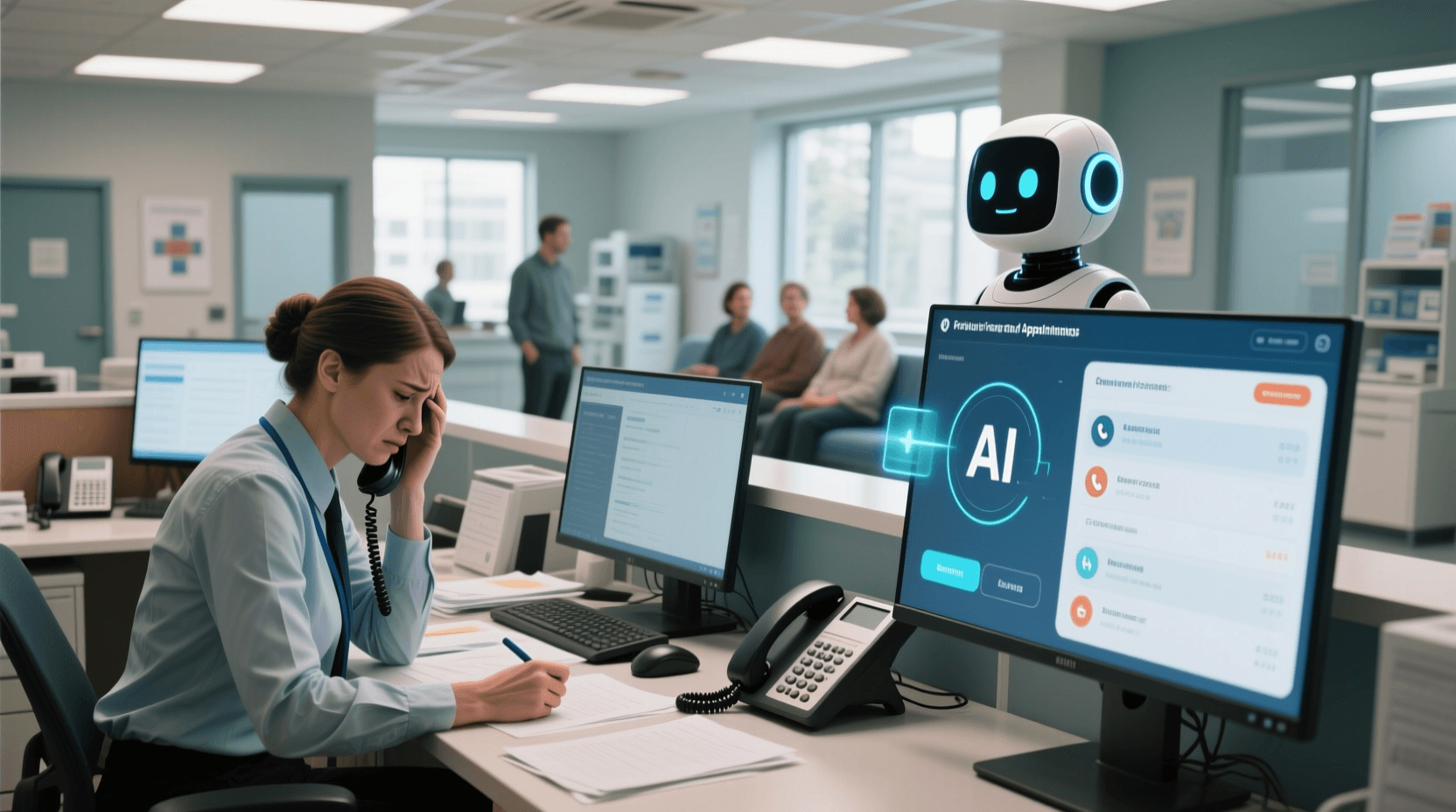
Patients often interpret silence from a doctor’s office as indifference. In reality, it is usually a systems failure.
The modern clinic is buried under phone calls, referral requests, insurance questions, appointment changes, medication renewals, lab follow-ups, and intake paperwork. The problem is not that healthcare workers do not care. The problem is that the communication layer around care was never designed for this volume, this complexity, or this level of fragmentation.
That is why one of the most important AI shifts in healthcare may not happen in diagnosis first. It may happen at the front desk.
Healthcare’s biggest bottleneck is operational, not clinical
When people think about AI in healthcare, they tend to imagine radiology models, medical scribes, or drug discovery. Those are exciting categories, but for most patients the experience of healthcare is shaped by something much more basic: whether anyone answers the phone.
Missed callbacks are rarely a single-person failure. They are the result of overloaded administrative workflows where every incoming request competes with ten others. A receptionist is expected to answer calls, verify insurance, route urgent messages, handle no-shows, process forms, and somehow still create a pleasant patient experience. In many practices, the “call you back later” promise is less a workflow than a survival tactic.
This is exactly the kind of environment where AI agents can create immediate value. Not because they replace clinical judgment, but because they absorb repetitive communication work before it spills over into patient dissatisfaction and staff burnout.
The first win for AI is responsiveness
In healthcare operations, speed is trust. A patient who gets an immediate response feels seen, even if the final resolution still requires a human. That means AI does not need to solve every problem to transform the experience. It just needs to reduce the black hole between request and response.
Tools like Answering Agent point to where this is going. A system that can provide nonstop phone support, book appointments, and handle high call volume consistently is not just a convenience feature. In a clinic setting, it can become a pressure valve for the entire practice. If routine requests are handled instantly, staff can focus on exceptions, escalations, and patient situations that genuinely need empathy or medical context.
That distinction matters. The best healthcare automation will not pretend every patient interaction is simple. It will identify which ones are simple enough to automate safely and which ones should move to a human immediately.
AI agents are becoming workflow infrastructure
The larger trend here is not “AI answers phones.” It is that AI agents are becoming a new operational layer for businesses with communication overload.
Healthcare is an especially strong fit because so much of its work is process-heavy, rules-based, and time-sensitive. Appointment scheduling, prior authorization prep, intake coordination, referral routing, billing follow-up, and post-visit reminders all involve structured tasks that are expensive when handled manually at scale.
This is where platforms such as Agent Smith become relevant beyond generic automation hype. Businesses want AI agents that reduce operating costs while scaling service quality, but in healthcare the more important metric may be recovered staff attention. Every repetitive call deflected or resolved automatically gives human workers more bandwidth for the moments where human judgment matters most.
Similarly, Morphal reflects another practical direction for the market: hybrid operations. Pure automation is rarely enough in a regulated, emotionally sensitive environment like healthcare. A model that combines AI agents with human specialists is often more realistic. The future medical office is unlikely to be fully autonomous; it is more likely to be an orchestrated system where AI handles intake, triage, and routine coordination while humans step in for nuance, edge cases, and patient reassurance.
The displacement debate misses the immediate reality
There is a familiar argument around AI in administrative work: does it augment staff or replace them?
That question matters, but it can also be premature. In many clinics, the immediate problem is not overstaffing. It is chronic overload. Teams are not defending idle time; they are trying to stay afloat. In that environment, AI is first adopted as shock absorption.
Over time, though, healthcare leaders will have to make choices. If AI can handle a large share of scheduling, reminders, intake, and call routing, practices may redesign staffing models around fewer generalist admin roles and more specialized patient support roles. That is not a trivial shift. It changes hiring, training, and what “front desk work” even means.
Developers building for this space should be honest about that. The winning products will not be the ones that market themselves as magical replacements. They will be the ones that prove they can reduce chaos, improve response times, document every action, and escalate safely.
What AI tool users should watch next
For AI buyers, the healthcare lesson extends far beyond medicine. Any industry with communication bottlenecks is a candidate for agent-based operations. Legal offices, home services, financial services, education, and logistics all face similar breakdowns when demand overwhelms human coordination.
The key evaluation criteria are becoming clearer:
- Can the AI respond instantly across peak volume?
- Can it complete real tasks, not just chat?
- Can it hand off cleanly to humans?
- Can it maintain auditability and consistency?
- Can it improve customer trust rather than erode it?
The doctor’s office callback problem is really a preview of a broader market transition. AI is moving from novelty to operational necessity in places where broken communication has become normalized.
Patients do not care whether the solution is called an AI agent, a virtual receptionist, or workflow automation. They care that someone answers, something happens, and the system no longer feels indifferent.
That is why this category matters. The next major AI breakthrough may not look like genius. It may look like finally getting a call back.