What Musk’s Energy Pivot Signals for the Next Wave of AI Infrastructure
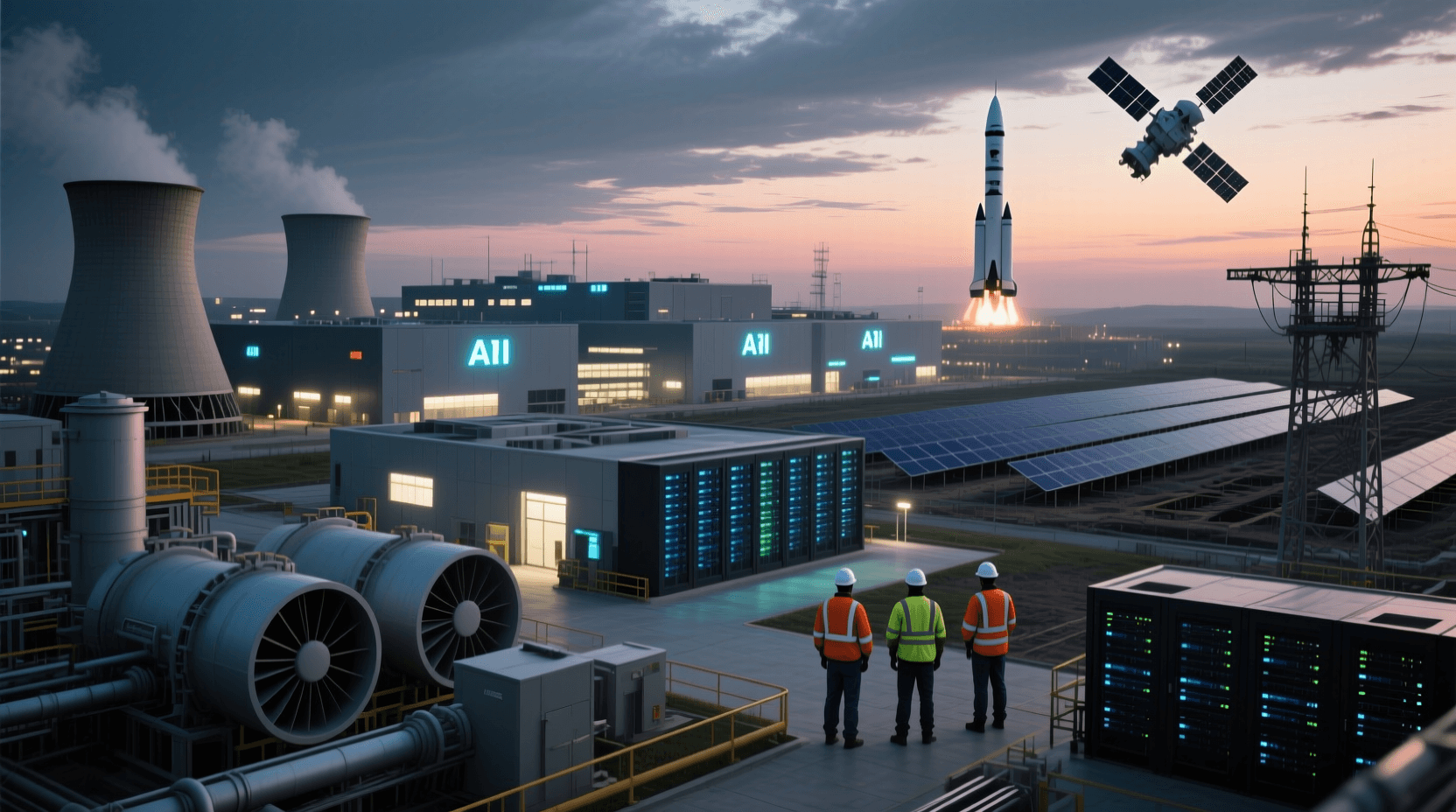
The most important AI story hiding inside the latest Elon Musk headlines is not really about Elon Musk. It is about a broader shift in the economics of intelligence.
For years, the dominant tech narrative treated clean energy and AI as naturally aligned. More compute would be matched by more renewables. More automation would optimize grids. More software would make energy abundance cleaner, cheaper, and smarter.
But when one of the world’s most visible futurists appears to lean away from Earth-based solar in favor of natural gas for AI-scale operations, it exposes an uncomfortable reality: when AI companies need power now, they often choose certainty over ideology.
AI doesn’t run on vision statements
The AI industry loves to talk about models, agents, and multimodal interfaces. But beneath every breakthrough is a brutally physical stack: transformers need chips, chips need cooling, and data centers need dense, continuous electricity.
That matters because the next stage of AI adoption is not limited by model quality alone. It is constrained by infrastructure deployment speed.
If natural gas is winning in some corners of AI infrastructure, it is not necessarily because executives stopped believing in renewables. It is because the market is rewarding whatever can be financed, permitted, and connected fast enough to support inference at scale.
This is a useful wake-up call for AI builders. The future of AI will not be determined only by which lab has the best model. It will also be shaped by who can secure reliable energy for training clusters, edge inference, and always-on agent systems.
Reliability is becoming a product feature
For users, “AI uptime” still feels like a software issue. For developers, it increasingly looks like an energy procurement issue.
That shift changes how we should evaluate AI platforms. Low latency, high availability, and real-time responsiveness are no longer just architecture decisions. They are downstream effects of power strategy.
This is especially relevant for voice AI, where delays are immediately noticeable. A tool like MAR8 - Text to Speech AI by CAMB.AI promises emotion-rich speech and extremely low latency. That kind of experience depends not just on good modeling, but on infrastructure that can deliver consistent performance under load. The same goes for MARS8 Text to Speech AI Models, where benchmark performance only matters if real-world deployment remains stable and affordable.
As AI becomes embedded in customer support, media production, gaming, education, and enterprise workflows, reliability stops being a backend concern. It becomes part of the user experience.
The green AI conversation is entering its awkward phase
There has been a tendency in AI marketing to imply that efficiency gains automatically translate into sustainability. Sometimes they do. Often they just enable more usage.
That is the rebound effect the industry still struggles to discuss honestly. If models get cheaper to run, companies do not simply save energy. They usually run more queries, add more features, expand to more markets, and keep systems online around the clock.
So Musk’s apparent pivot should not be read as one billionaire changing his mind. It should be read as a sign that AI’s energy appetite is colliding with the slower timelines of clean infrastructure.
For AI users, this means sustainability claims deserve more scrutiny. Ask whether a vendor is reducing total energy intensity, or simply optimizing cost per inference while total consumption rises. Those are very different stories.
For developers, this means “efficient model design” is no longer enough as a talking point. Teams will increasingly need to think about workload scheduling, regional deployment, hardware utilization, and whether every feature truly needs to be real time.
Agents will make the power question even bigger
The next wave of demand may come less from chatbots and more from autonomous systems that operate continuously.
Agentic AI is exciting because it promises software that can monitor, decide, act, and iterate without constant human prompting. But persistent agents also create persistent compute demand. A single chat session ends. An autonomous research, operations, or customer-service agent may run indefinitely.
That makes platforms like EvoAgentX especially interesting. A self-evolving ecosystem of AI agents hints at where the market is headed: more orchestration, more autonomy, and more background computation. If that future arrives at scale, the infrastructure question becomes impossible to ignore. The industry will need not just smarter agents, but smarter energy-aware agent design.
Developers who build in this space should start planning for energy as a systems constraint, not an externality. Agent loops need guardrails. Task delegation needs efficiency metrics. “Always on” should be justified, not assumed.
Orbital fantasies, terrestrial constraints
The fascination with orbital data centers says something revealing about the AI sector’s mindset. Rather than adapt product ambition to today’s grid constraints, some leaders seem more interested in escaping the problem entirely.
That may sound visionary, but it also underscores how severe the terrestrial bottleneck has become. When compute demand grows faster than practical clean power deployment, even improbable ideas start sounding strategic.
Still, most AI companies will not launch their infrastructure into orbit. They will make ordinary decisions about cloud regions, power contracts, model compression, and latency budgets. That is where the real future of AI infrastructure will be decided.
What this means now
The takeaway is simple: AI is entering its industrial phase.
In the consumer era, the big questions were interface and capability. In the industrial era, the big questions are energy, supply chains, and operational resilience.
Users should expect more differentiation between AI products that look similar on paper but perform very differently in practice. Developers should expect infrastructure strategy to become part of product strategy.
And the rest of us should stop pretending that AI’s future will be settled by model demos alone. The winners may be the companies that pair strong intelligence with credible, scalable, and honest power economics.