Why AI Growth in the Gulf Depends on More Than Bigger Data Centers
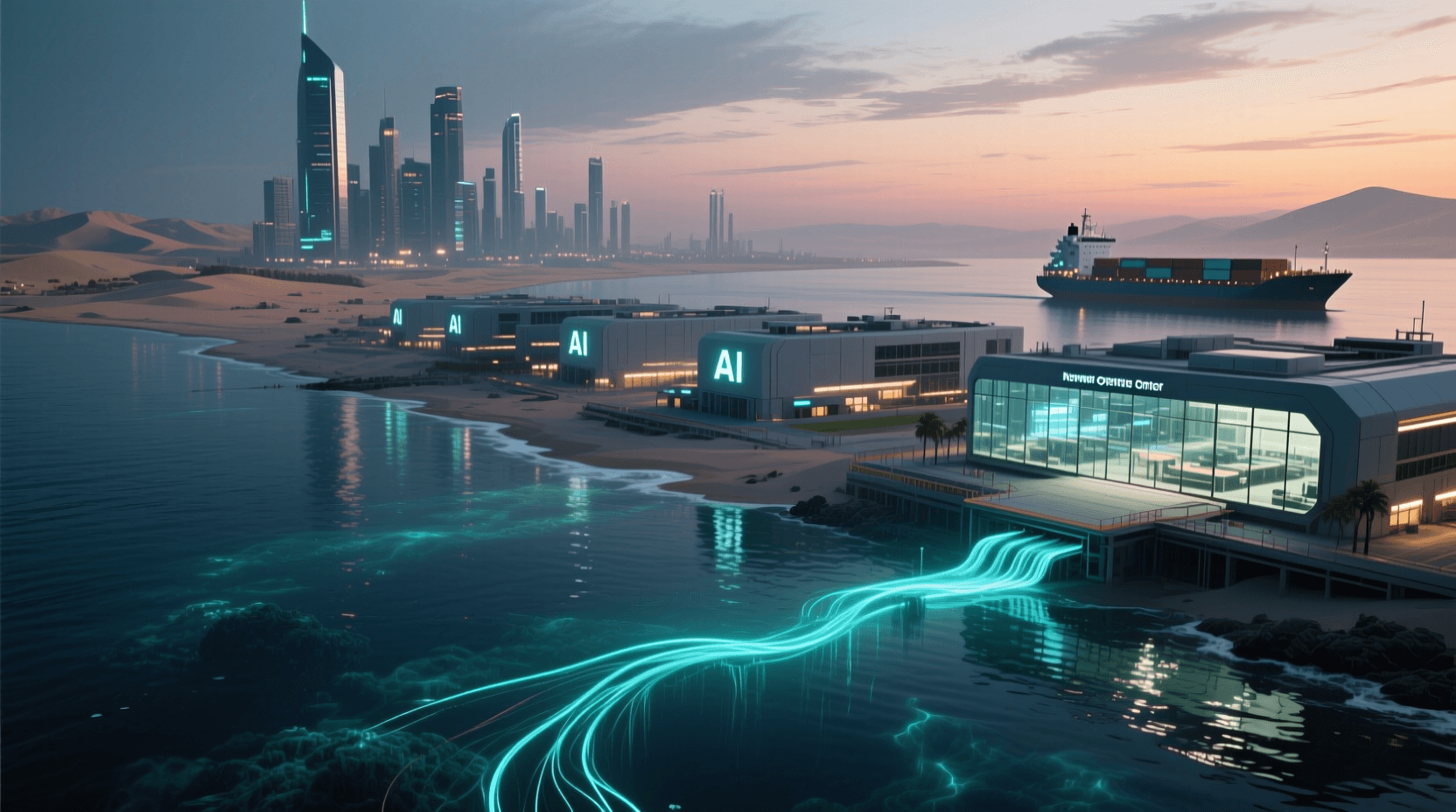
The next phase of AI infrastructure won’t be won by compute alone. It will be won by whoever treats connectivity as part of the model stack.
For years, the AI race has been framed around chips, power, and talent. That framing made sense when the biggest bottleneck was access to GPUs. But as AI investment accelerates across the Gulf, a more foundational issue is moving into view: if data can’t move reliably, AI systems can’t scale reliably either.
That matters because modern AI is not a single-server story. It is a distributed system story. Training happens in one place, inference in another, data pipelines somewhere else, and users everywhere. In that world, subsea cables are not a background utility. They are strategic infrastructure.
AI turns network resilience into a product issue
The old internet tolerated some fragility because many digital services could degrade gracefully. A slow page load was annoying, but survivable. AI changes that equation.
When enterprises deploy copilots, autonomous workflows, multimodal search, or real-time analytics, latency and uptime stop being abstract network metrics. They become user experience, SLA compliance, and revenue protection. If a cable cut or routing bottleneck interrupts access between cloud regions, model endpoints, and enterprise data stores, the result is not just inconvenience. It can mean halted operations, failed automations, and broken trust in AI products.
This is especially important in regions trying to become AI hubs rather than just AI customers. The Gulf has the capital, ambition, and energy strategy to support major AI buildouts. But the more it attracts hyperscalers and model-intensive workloads, the more it inherits the fragility of global internet plumbing.
That is why AI builders should stop thinking of connectivity as something the telecom team handles later. It belongs in architecture decisions from day one, right alongside model choice and infrastructure spend.
The real lesson: local AI capacity matters more now
One likely consequence of network risk is a stronger push toward regionalized AI infrastructure. Not every workload should depend on long-haul connectivity to another continent, especially when the application is latency-sensitive, regulated, or mission-critical.
This is where modular and edge-oriented deployment models become more interesting than they looked a year ago. A tool like ModulEdge points toward a practical response: bring scalable AI and edge compute closer to where demand actually exists. If subsea connectivity becomes a strategic constraint, then modular data center design is not just an efficiency play. It is a resilience play.
For governments, financial institutions, logistics operators, and healthcare networks in the Gulf, the question is no longer simply, “How do we get more compute?” It is, “Which workloads must remain operational even when international links are stressed?” Once you ask that question, local inference, regional failover, and hybrid deployment become much easier to justify.
Developers should design for cable failure, not just cloud failure
There is a tendency in AI development to assume the cloud is infinitely available as long as a provider has multiple regions. But physical networks still connect those regions, and physical networks fail.
Developers building AI products for Gulf markets should start treating undersea cable disruption as a realistic design scenario. That means:
- caching critical context and embeddings locally
- supporting degraded but functional modes of operation
- planning multi-provider routing and regional redundancy
- separating mission-critical inference from nonessential batch jobs
- reducing dependence on remote APIs for core product features
This is also where dedicated infrastructure becomes strategically attractive. Teams relying heavily on external shared AI services can find themselves exposed not only to latency spikes and outages, but to unpredictable performance during periods of regional stress. Workhorse, which provides private, dedicated AI coding infrastructure, reflects a broader market shift: developers increasingly want consistency, privacy, and control rather than best-effort access to distant AI resources.
That trend may spread beyond coding agents. As AI becomes embedded into enterprise operations, dedicated and localized infrastructure will look less like a premium option and more like a risk-management requirement.
The Gulf could become a model for infrastructure-aware AI
There is a bigger opportunity here. Regions that face infrastructure constraints early often end up building smarter systems.
The Gulf’s AI expansion could push organizations to create more fault-tolerant architectures, better regional data strategies, and more intentional deployment patterns. Instead of copying the “centralize everything in a few giant clusters” approach, they may adopt a more distributed model that balances hyperscale compute with local capacity.
That would be good not just for the Gulf, but for the broader AI ecosystem. It would force the market to mature beyond raw model obsession and focus on end-to-end operational reality.
In that sense, the infrastructure challenge is not only a risk. It is a filter. It separates AI ambition from AI readiness.
Platforms like Super AI Boom, which track the expanding impact of artificial intelligence, are useful reminders that AI growth is not just about what models can do. It is about the systems, dependencies, and chokepoints that determine whether those models can deliver value in the real world.
What AI buyers should ask now
If you are adopting AI tools or building AI services in the Gulf, ask tougher infrastructure questions before scaling:
- Where does inference actually run?
- What happens if cross-border connectivity degrades for 6, 12, or 24 hours?
- Which workflows need local continuity?
- How portable are your models, vector stores, and orchestration layers?
- Are you buying intelligence, or just renting distant availability?
The winners in the next AI cycle will not just have the best models. They will have the most resilient delivery systems.
And in fast-growing AI markets, resilience may start on the ocean floor.