Why Dynamic AI Workflows Could Matter More Than the Next Bigger Model
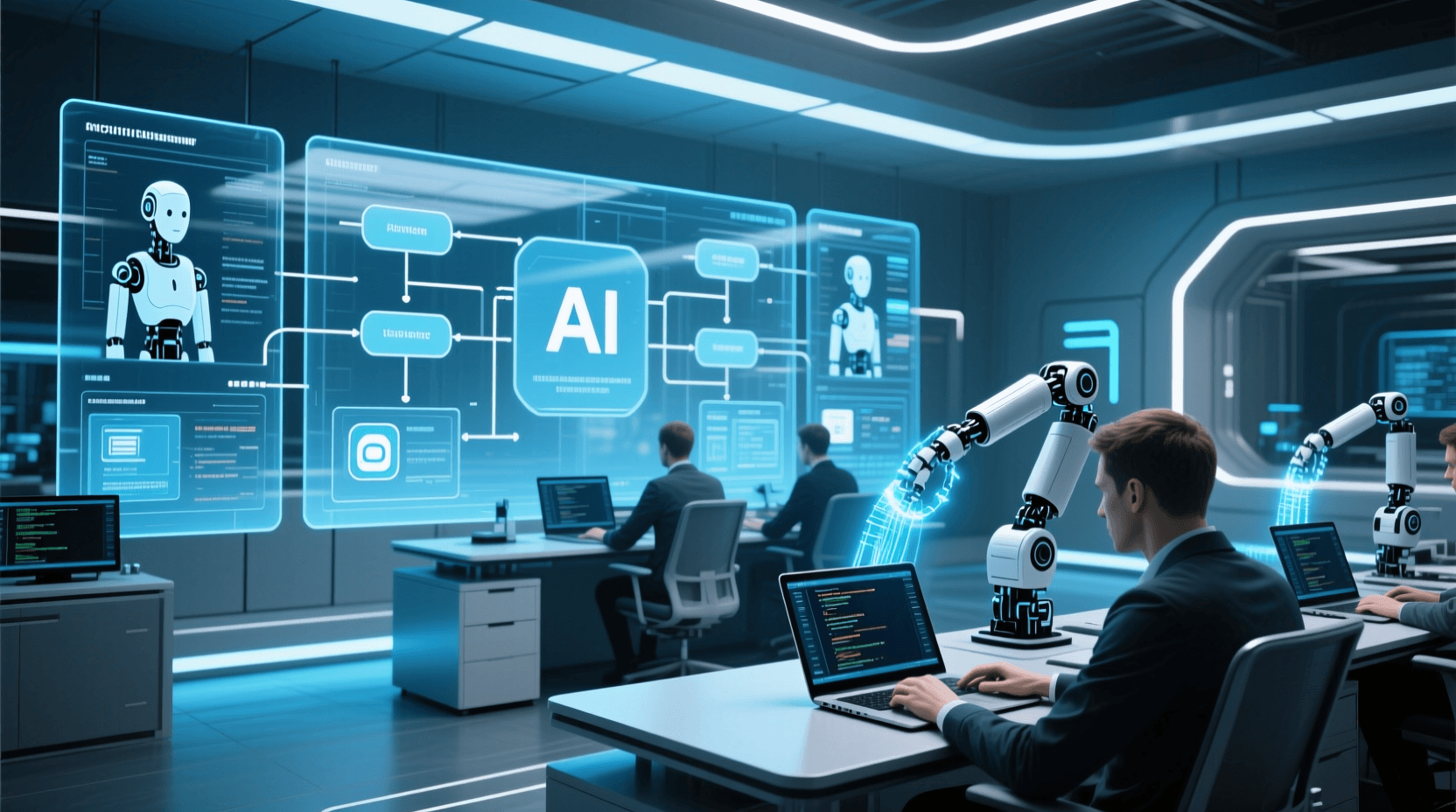
The most interesting part of the latest model announcements isn’t raw benchmark performance anymore. It’s orchestration.
Anthropic’s new emphasis on a “dynamic workflow” capability points to a bigger shift in AI product design: the future won’t be one giant model answering one giant prompt. It will be networks of specialized agents coordinating in real time, handing off tasks, checking each other’s work, and adapting the plan as new information arrives.
That matters because most real business problems are not single-turn problems. They are messy, multi-step, and full of dependencies.
The age of the solo chatbot is ending
For the last two years, much of the AI market has been built around a simple interface pattern: user asks, model responds. That works for drafting emails, brainstorming ideas, or summarizing documents. But it starts to break down when the task includes research, execution, validation, retries, and tool use across multiple systems.
A useful AI worker for modern teams has to do more than generate text. It has to coordinate.
Think about a product launch workflow. One agent could gather competitive intelligence. Another could draft positioning. A third could generate ad variants. A fourth could verify claims against source material. A fifth could push approved outputs into project management and CRM tools. The value is no longer just “smart output.” It’s controlled delegation.
That’s why dynamic workflows are important. They reflect a move from AI as a single assistant to AI as an operating layer.
Why subagents are becoming the real product
The phrase “swarm of subagents” may sound futuristic, but the underlying idea is practical: break a complex problem into smaller roles, assign each role a bounded objective, and let a coordinator manage the sequence or parallelism.
This approach solves several persistent issues in AI deployments:
- It reduces context overload by giving each agent a narrower job.
- It improves reliability because one agent can review or challenge another.
- It makes systems easier to debug since failures can be traced to a step, not a monolith.
- It enables cost control by reserving premium reasoning only for the hardest parts.
For developers, this is a major architectural shift. Prompt engineering alone is no longer enough. Now the challenge is designing agent topologies: when to branch, when to merge, when to escalate to a stronger model, and when to keep a human in the loop.
That is where platforms in the broader agent ecosystem become highly relevant.
For teams that want to automate real operational workflows without building everything from scratch, Activepieces is a strong example of where the market is heading. Its no-code and open-source approach makes it easier to connect AI agents to actual business actions, not just chat interfaces. Dynamic workflows become much more valuable when they can trigger approvals, update systems, and move data across apps automatically.
The next battleground is agent management, not just model quality
As more labs ship stronger models, differentiation will increasingly come from workflow control, observability, and safety boundaries.
A company using multiple subagents will need answers to practical questions:
Who spawned which agent? Which tools did it access? Why did it choose one branch over another? How do you stop runaway task expansion? How do you review outputs before they hit production systems?
These are not model questions. They are systems questions.
That’s why the rise of multi-agent development environments is so important. Agentastic.dev is a good example of tooling that fits this new reality. If developers are going to run many coding agents in parallel, isolated worktrees and containerized environments stop being a nice-to-have and become basic infrastructure. Once you move from “one coding copilot” to “30+ agents working simultaneously,” isolation, review, and reproducibility become essential.
In other words, dynamic workflows create demand for a whole new software stack around them.
Self-improving agent ecosystems are no longer a niche idea
Another implication is that orchestration naturally leads to evolution. Once agents can be assigned, measured, and compared, teams will want systems that learn which structures work best.
That’s where projects like EvoAgentX become especially interesting. The idea of a self-evolving ecosystem of AI agents aligns closely with where the industry seems to be moving. If workflows can dynamically assemble subagents today, the next step is obvious: let the system refine those agent combinations over time based on outcomes, latency, cost, and accuracy.
For AI builders, this could become the real moat. Not just having access to a frontier model, but building an environment where agent teams continuously improve.
What this means for AI tool users
If you’re a buyer or operator, the takeaway is simple: stop evaluating AI tools only by how impressive the demo looks. Start asking how they handle multi-step work.
The most valuable AI products over the next year will likely be the ones that can:
- decompose tasks intelligently,
- coordinate specialized agents,
- connect to business systems,
- enforce review and governance,
- and adapt workflows without constant manual redesign.
That is a much more useful standard than “writes great prose” or “feels fast in chat.”
The real opportunity is not replacing one employee with one model. It’s redesigning workflows so machine intelligence can operate as a structured team.
The bigger picture
Dynamic workflow tooling signals that the AI market is maturing. We are moving past the phase where intelligence alone was enough to impress. The next phase is about organized intelligence.
For users, that means better automation of real work. For developers, it means a new design discipline centered on agent coordination. And for the broader ecosystem, it means the winners may not be the companies with only the smartest models, but the ones that make many models and agents work together safely, visibly, and productively.
That’s the shift worth watching.