Why Meta’s Robotics Move Signals a New Battle for Embodied AI
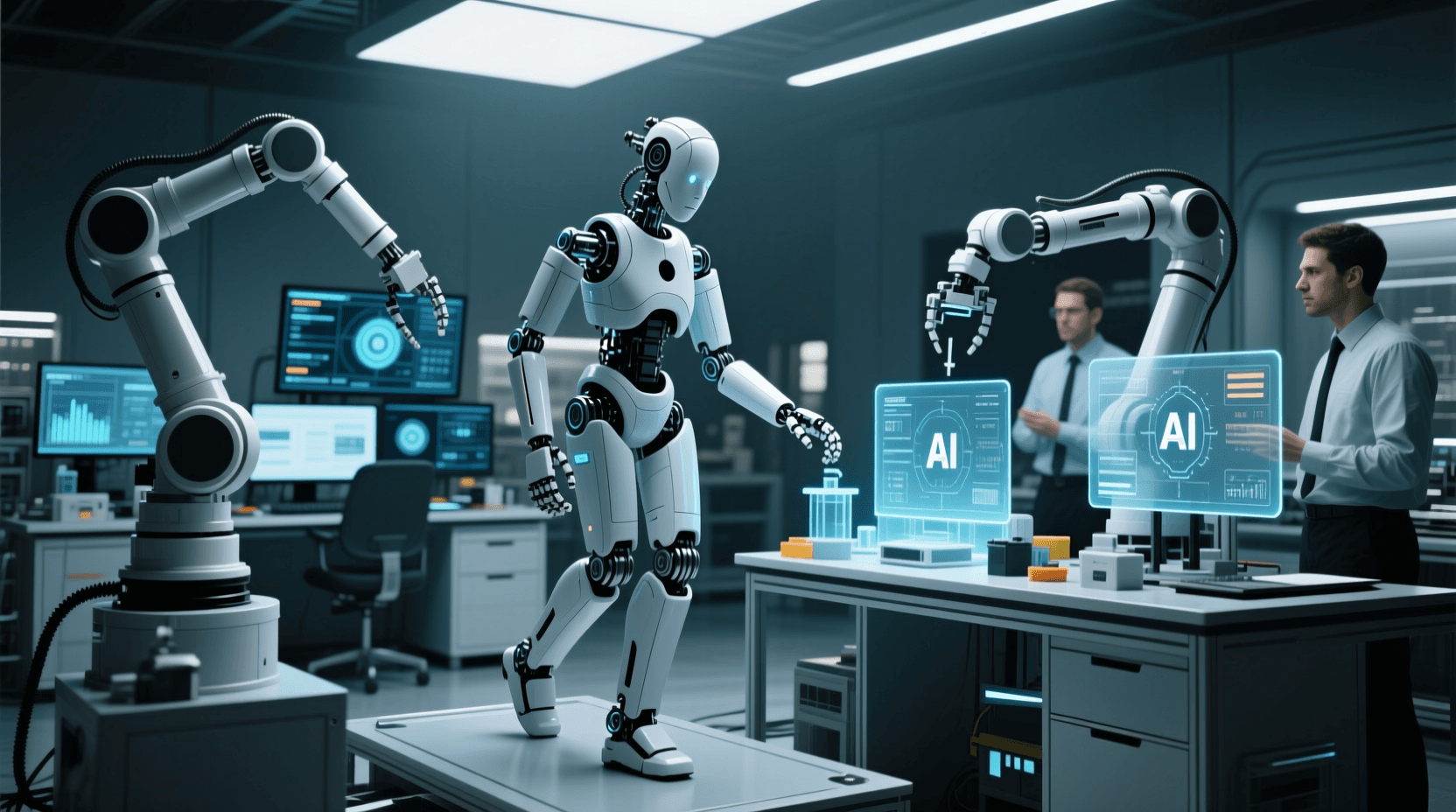
Meta’s latest robotics acquisition matters for a reason that goes beyond corporate expansion: it signals that the next major AI platform war may not be fought only in chat windows, copilots, or image generators. It may be fought in the physical world.
For the last two years, most AI users have interacted with intelligence as software. You type a prompt, get an answer, and move on. But humanoid robotics changes the stakes. Once AI can see, move, manipulate objects, and respond in real time, the industry stops optimizing only for language quality and starts optimizing for action quality.
That shift has huge implications for tool builders, model providers, and anyone betting on AI products today.
From generative AI to embodied AI
The real significance of Meta investing more deeply in robotics is that it suggests frontier labs increasingly see embodiment as the next proving ground for general-purpose intelligence. It’s one thing for a model to explain how to fold laundry or stock a shelf. It’s another for a machine to do it reliably in messy, unpredictable environments.
That gap between knowing and doing is where a lot of current AI hype gets tested.
Developers have spent the past few years building around text, code, image, and video models. Those categories remain important, but robotics introduces a tougher stack: perception, planning, memory, motion control, safety, latency, and continuous learning. A robot can’t hide behind a polished demo if it drops a box, misreads a room, or freezes in front of a staircase.
This is why Meta’s move is more strategic than it first appears. The company is not just chasing robots as hardware. It is chasing the data, training loops, and multimodal intelligence required to make AI useful in embodied settings.
Why this matters for AI tool users
If you use AI tools today, robotics may feel distant. But the effects will likely show up in software long before most businesses ever buy a humanoid machine.
Robotics forces AI systems to become better at grounding. In practice, that means models that understand space, objects, intent, timing, and consequences more accurately. Those improvements can spill back into everyday tools: smarter assistants, more reliable agents, better vision systems, and more context-aware automation.
For example, companies focused on reliability and steerability, like Anthropic, are especially relevant in this transition. In robotics, “mostly correct” is not enough. A hallucinated paragraph is annoying; a hallucinated physical action can be dangerous. The push toward embodied AI will reward systems that are interpretable, constrained, and dependable under uncertainty.
That should be welcome news for enterprise buyers. The robotics race may end up accelerating safer AI design patterns across the board.
The new premium: real-world data
One underappreciated consequence of the robotics push is that synthetic benchmarks may matter less than real-world interaction data. In software AI, companies can often improve products with internet-scale text and user prompts. In robotics, they need examples of movement, failure, recovery, and adaptation in physical environments.
That creates a new premium on proprietary data pipelines.
The winners may not simply be the labs with the biggest models. They may be the companies with the best closed-loop systems: sensors, simulations, human feedback, edge deployment, and operational telemetry. This is where Big Tech has an advantage, because it can fund expensive experiments for years before the economics fully make sense.
For startups, that means the opportunity may be narrower but still compelling. Instead of trying to build a full humanoid stack, many will likely do better by specializing in perception modules, safety layers, simulation tooling, workflow orchestration, or industry-specific robot behaviors.
Digital humans and physical humans are converging
There’s another interesting angle here: the line between robotics AI and avatar AI is getting thinner.
Platforms like Omnihuman AI, which generate realistic digital character videos with synchronized lip-sync and dynamic responses, point to a broader market demand: people want AI that feels embodied, responsive, and socially legible. Sometimes that embodiment is physical; sometimes it’s visual and conversational.
The same user expectations are emerging in both categories. People want AI systems that can communicate naturally, react in context, and appear coherent across voice, vision, and action. A humanoid robot in a warehouse and a digital human in a customer service flow are different products, but they increasingly draw from the same multimodal foundations.
That means developers should stop thinking of “robotics” as a niche separate from mainstream AI. It’s part of a larger trend toward agents that operate across modalities and environments.
What developers should do now
For builders, the practical takeaway is clear: design for action, not just output.
Even if you are not building robotics products, the market is moving toward AI systems that must observe, decide, and execute with tighter feedback loops. That means more emphasis on tool use, memory, monitoring, evaluation, and rollback mechanisms. It also means multimodal capability is becoming less optional.
Staying informed on these shifts matters. Resources like Bitbiased AI can help developers and founders track where the market is moving, especially as AI headlines increasingly blur the lines between software, hardware, and business strategy.
The bigger picture
Meta’s robotics move is a reminder that the AI industry is entering a more physical phase. The chatbot era taught the world what generative models can say. The robotics era will test what AI can do.
For users, that should lead to more capable and grounded products. For developers, it raises the bar. The future won’t belong only to systems that sound intelligent. It will belong to systems that can act intelligently in the real world—or at least convincingly bridge the gap between digital understanding and physical execution.