Why Nvidia’s Bet on AI Agent CPUs Could Reshape the Next Enterprise Stack
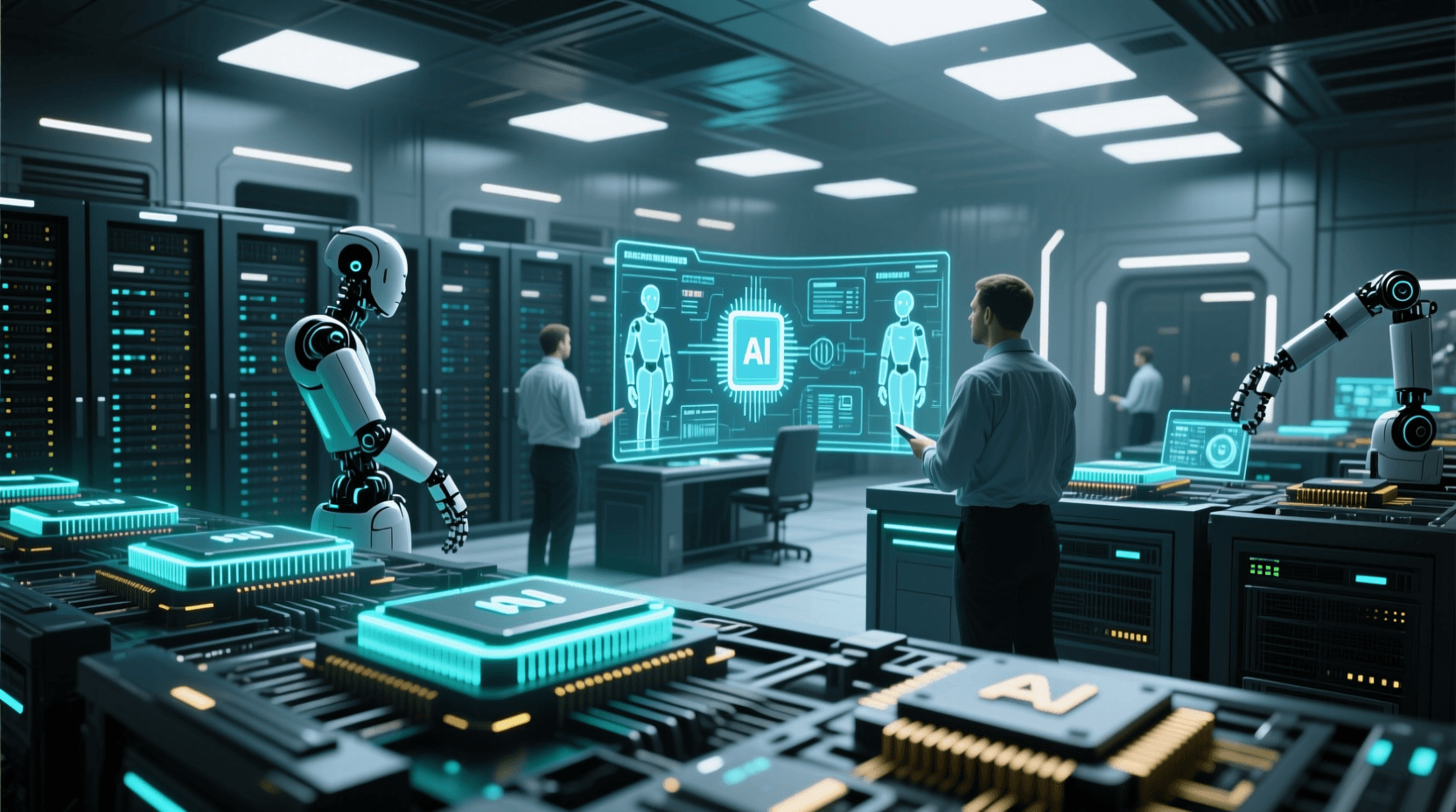
The most interesting part of Nvidia’s latest narrative isn’t the size of the opportunity. It’s the category shift.
For years, the AI infrastructure conversation has been dominated by one idea: bigger models need more GPUs. That story is still true, but it’s no longer the whole story. If AI agents become a standard layer inside business software, then the market won’t just be about training clusters and inference accelerators. It will be about the full compute stack needed to run persistent, decision-making software workers at scale.
That is a very different market, and it helps explain why CPUs are suddenly back at the center of the AI conversation.
AI agents don’t just generate tokens
A lot of AI hype still treats intelligence as a chatbot problem. Ask a question, get an answer, move on. But agents are operational systems. They plan, call tools, retrieve data, monitor state, trigger workflows, and coordinate with other software. In practice, that means they don’t just need raw model inference. They need orchestration.
And orchestration is where CPUs matter.
An AI agent inside a company isn’t simply producing language. It’s checking permissions, querying databases, managing memory, handling retries, calling APIs, parsing documents, and interacting with legacy systems. Those are classic CPU-heavy tasks. The GPU may remain the star for model execution, but the CPU becomes the traffic controller for everything around it.
This matters for developers because the next wave of AI products will likely be judged less by benchmark scores and more by operational reliability. The winners won’t just have the smartest model. They’ll have the most dependable runtime for agents that can actually complete work.
The real market is not chips, it’s agent infrastructure
When executives talk about a massive new market, it’s easy to focus on silicon revenue. But for AI builders, the bigger takeaway is that the industry is starting to price in agent infrastructure as a durable software category.
That should get the attention of anyone building tools, workflows, or marketplaces around AI automation. If enterprises are preparing for fleets of agents, they will need systems for discovery, deployment, governance, and specialization. That creates room for platforms like TrillionAgent, which approaches the space from a practical angle: a marketplace of AI agents across hundreds of roles. If the future enterprise stack includes many specialized agents rather than one monolithic assistant, marketplaces become a natural distribution layer.
This is the part many people miss. The agent economy won’t be won by one giant general-purpose model alone. It will likely be assembled from many narrow, task-oriented agents connected to business systems. That means the infrastructure opportunity extends beyond Nvidia and into every layer above the hardware.
Why this could change software buying behavior
If agent workloads become common, companies may stop buying software the way they do today.
Instead of purchasing a SaaS seat for every workflow, businesses may increasingly pay for outcomes: leads qualified, reports generated, support tickets resolved, videos produced, code reviewed. That subtle shift changes what enterprise buyers care about. They may ask fewer questions about UI polish and more questions about throughput, observability, and cost per completed task.
That is good news for developers who can build agent-native products from the ground up. It is less comfortable for incumbents whose products assume a human sits in front of a dashboard all day.
It also creates interesting openings in creative AI. Video generation, for example, is often discussed as a pure model problem, but production pipelines are full of agent-like coordination tasks: prompt iteration, asset selection, style consistency, rendering decisions, and publishing workflows. Tools like Framepack AI hint at how efficient model design can broaden access to advanced generation on consumer hardware. As AI agents become more capable, expect them to sit on top of tools like this and automate larger parts of content production.
Developers should prepare for hybrid compute thinking
The old mental model was simple: AI equals GPU demand. The new model is more nuanced. Agent systems will require a blend of GPUs, CPUs, memory optimization, networking, storage, and software orchestration.
For builders, that means product architecture decisions suddenly matter more than model selection alone. Can your app split tasks intelligently between inference-heavy and logic-heavy workloads? Can it keep costs predictable when agent usage spikes? Can it support real-time tool use without becoming brittle?
The teams that win in this next phase will think like systems engineers, not just prompt engineers.
That broader perspective is also why the market remains so dynamic. We are still in the stage where the rules are being written in real time. If you want a wider view of how fast this ecosystem is expanding, Super AI Boom captures the scale and momentum of the shift well. The important point is not that AI is growing. It’s that the shape of growth is changing—from isolated model demos to interconnected agent economies.
The bigger signal behind Nvidia’s claim
Whether the precise dollar figure proves right is almost secondary. The deeper signal is that one of the most important companies in AI infrastructure believes the center of gravity is moving toward agents as a core computing paradigm.
That should influence how startups pitch, how enterprises budget, and how developers design products. We are moving from an era of “AI features” to an era of “AI workers.” And AI workers require a lot more than a model endpoint.
If Nvidia is right, the next major battleground won’t just be who builds the smartest AI. It will be who builds the most scalable environment for agents to operate inside real businesses.
For AI tool users, that means more specialized, useful automation is coming. For developers, it means the stack is opening up again. And whenever the stack opens up, new winners emerge.