Why Open Physical AI Models Could Reshape Robotics Faster Than Chatbots Did
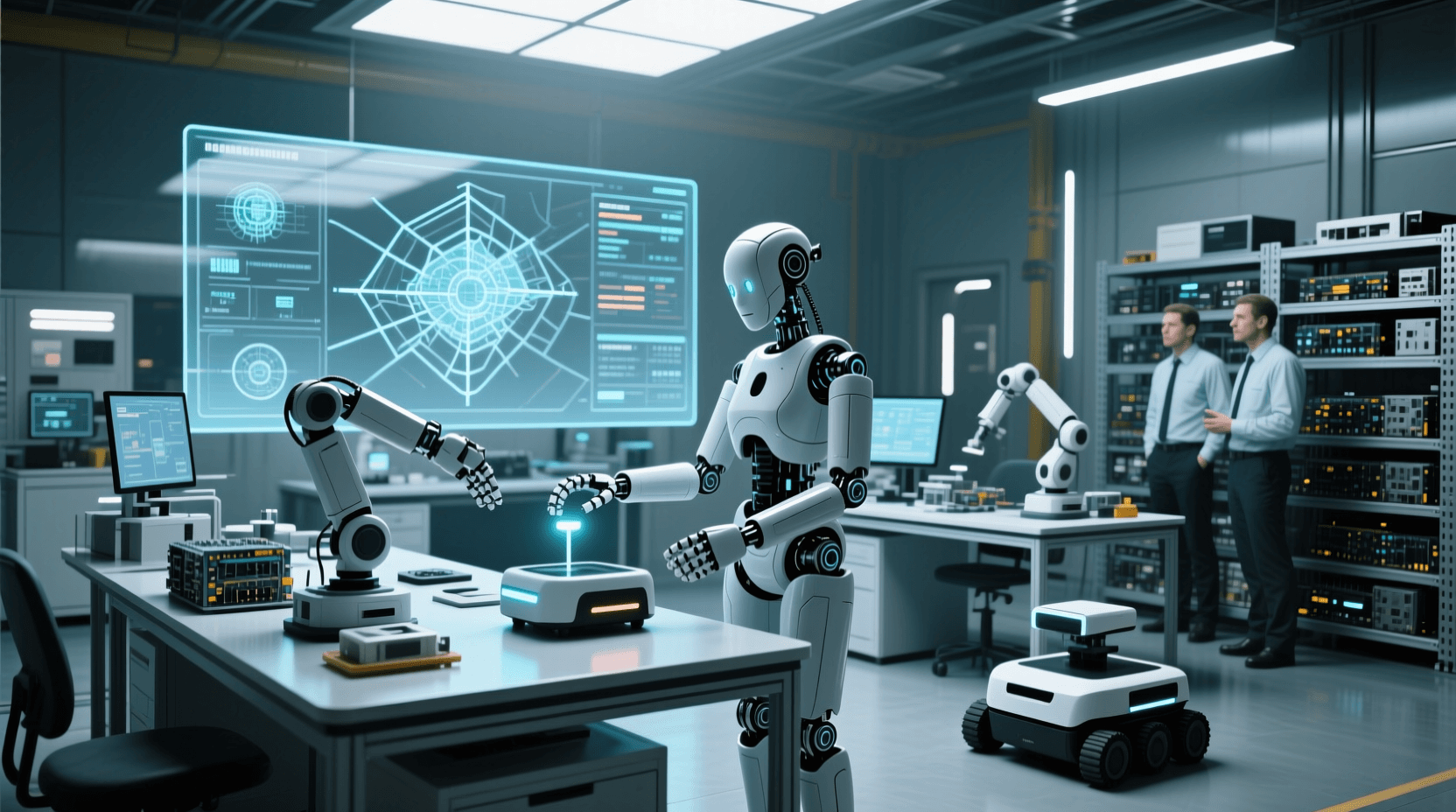
The next big AI platform shift may not happen on your screen. It may happen in warehouses, factories, labs, retail aisles, and eventually homes.
A new class of open models aimed at physical reasoning and action signals something larger than another foundation model launch. It points to a future where AI is no longer judged only by how well it writes, codes, or chats, but by how reliably it can interpret the real world and help machines do useful work inside it.
That matters because physical AI has historically been much harder to democratize than language AI. Large language models spread quickly because text is abundant, interfaces are simple, and deployment is mostly software. Robotics is the opposite: data is messy, environments are unpredictable, and every real-world action carries cost, risk, and latency. If open omni-models for physical reasoning start becoming practical, they could compress years of experimentation for developers building embodied systems.
From language intelligence to world intelligence
The AI industry has spent the last two years optimizing for digital tasks: generate content, answer questions, automate workflows, write code. Tools like OpenAI helped define that era by making general-purpose intelligence accessible through APIs and products that fit neatly into existing software stacks.
Physical AI changes the design target. Instead of asking, "Can the model produce a good answer?" developers ask, "Can the system perceive, reason, predict consequences, and choose an action under uncertainty?"
That shift is profound. A robot assistant in a warehouse does not just need vision. It needs situational judgment. It must understand objects, motion, space, timing, and failure modes. It must infer when not to act. In practice, this means multimodal models for the physical world need to combine perception, simulation, planning, and action policies in ways that go beyond today’s typical chatbot architecture.
The phrase “open omni-model” is especially important here. Openness in physical AI could do for robotics what open-source LLMs did for app development: lower experimentation costs, expand community research, and create a shared foundation that startups can adapt for narrow, high-value use cases.
Why developers should pay attention now
For AI developers, the most interesting implication is not that robots are suddenly solved. They are not. The important point is that the tooling stack is maturing.
When model builders start treating physical reasoning as a general-purpose capability rather than a bespoke robotics problem, developers gain leverage. Instead of training everything from scratch for each arm, drone, or mobile platform, teams can begin with a broader model that already understands visual dynamics, object interactions, and action planning patterns.
That could unlock three practical changes.
First, simulation becomes more central. Developers will increasingly build systems that learn in synthetic environments before touching expensive hardware. This creates a bridge to generative media models, where world modeling is already advancing quickly. Tools like OpenAI Sora hint at where this gets interesting: richer generative models can help create plausible scenarios, edge cases, and environment variations for testing embodied agents. The line between video generation and world simulation is thinner than many people think.
Second, multimodal interfaces will matter more than pure text prompts. In physical AI, inputs are images, depth maps, sensor streams, audio, task constraints, and human demonstrations. Teams that already understand multimodal orchestration will have an advantage.
Third, evaluation becomes the real moat. In software AI, a bad output is often annoying. In physical AI, a bad output can break equipment or create safety issues. The winners will not just have impressive demos. They will have rigorous benchmarks for reliability, recovery behavior, and human override.
What this means for AI tool users
For end users and businesses, open physical AI models could gradually make automation feel less scripted and more adaptive. Today, many robotic systems are brittle outside tightly controlled environments. Tomorrow’s systems may be able to generalize better across layouts, lighting conditions, object variations, and ambiguous instructions.
That does not mean humanoid robots will instantly arrive everywhere. The nearer-term impact is more likely to show up in specialized workflows: industrial inspection, logistics, retail assistance, telepresence, training, and digital-to-physical workflow coordination.
There is also an overlooked human layer here. As physical AI improves, digital humans and embodied interfaces become more useful, not less. Platforms like Omnihuman AI point toward a future where realistic digital agents can train workers, guide customers, or act as the conversational layer on top of physical systems. In many industries, the first successful embodiment strategy may not be a fully autonomous robot. It may be a hybrid system where a digital human handles communication while physical automation handles constrained tasks.
The real opportunity: open ecosystems over closed demos
The AI market loves polished launch videos, but developers should focus on ecosystem effects. Open physical AI models matter most if they encourage shared datasets, reproducible benchmarks, interoperable tooling, and community fine-tuning.
That is how the market moves from spectacle to infrastructure.
For startups, this is a chance to build vertical products on top of generalized physical reasoning. For enterprises, it is a signal to start experimenting with embodied AI now, especially in simulation-heavy or safety-bounded settings. For tool users, it means the next wave of AI value may come from systems that can perceive and act, not just generate.
If the last generation of AI taught machines to speak our language, the next one may teach them to navigate our world. And once that happens, the software industry will stop being the only place where foundation models scale.