Why Remote AI Coding Agents Change the Stack More Than Another Benchmark Win
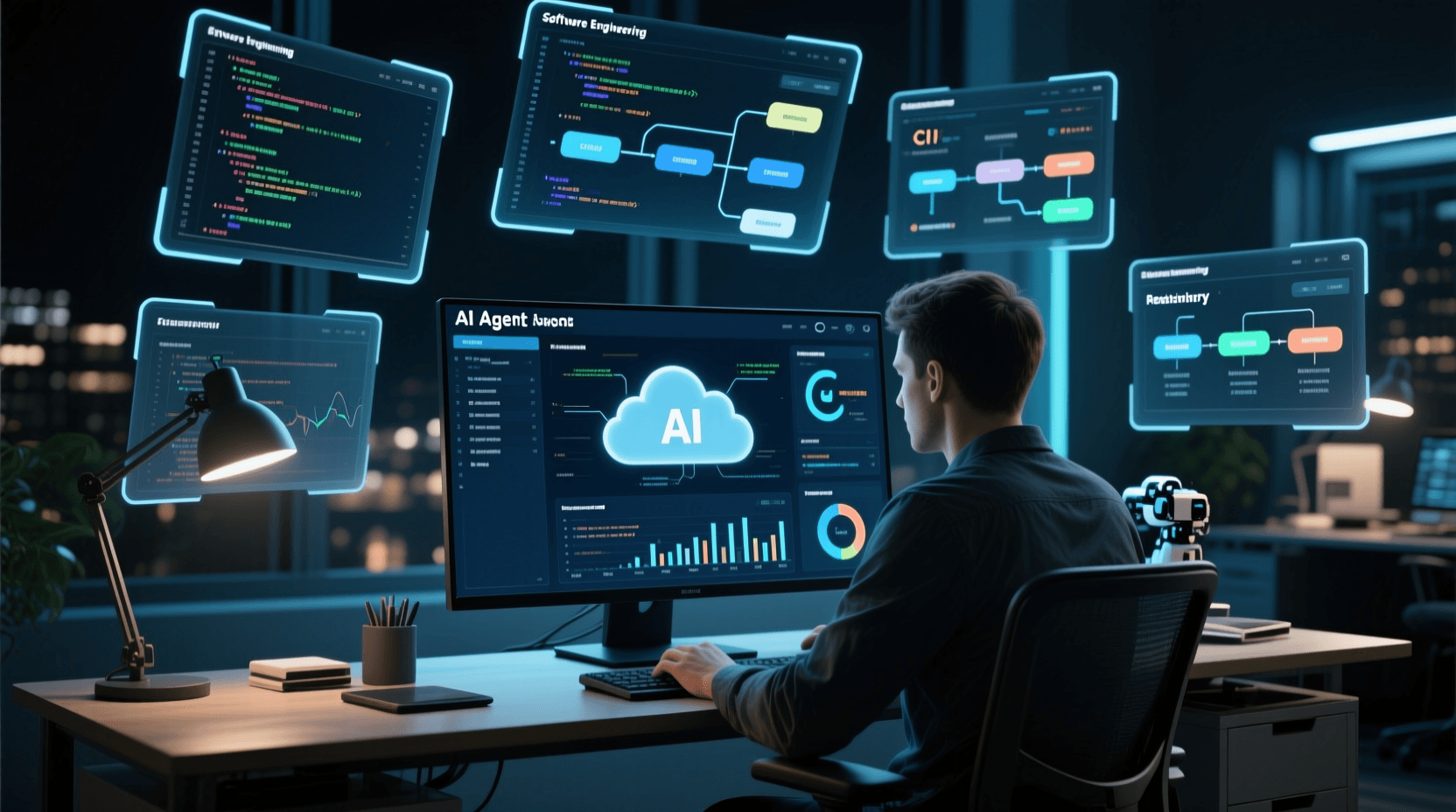
AI model launches usually get framed around one number: benchmark score, context window, latency, price. But the more important shift is often architectural. The latest wave of remote, cloud-executed coding agents points to a bigger change than a stronger model release: AI is moving from being a chat interface that suggests code to becoming an operational layer that can work asynchronously, persist state, and act across longer software tasks.
That matters more to builders than any single leaderboard result.
The real story is not “better coding,” it’s delegated execution
For the last two years, many developers have used AI as an autocomplete-plus system. You ask, it answers. You paste logs, it proposes a fix. You request a refactor, it generates one. Useful, yes — but still fundamentally synchronous and human-tethered.
Remote agents change that pattern. Instead of keeping the model trapped inside a chat box or local IDE session, the agent can run in the cloud, maintain task continuity, and work through multi-step jobs over time. That means the unit of value is no longer “one prompt, one answer.” It becomes “one objective, many actions.”
This is the moment where AI starts to look less like a smarter assistant and more like a junior execution environment.
For developers, that unlocks a new workflow category: assign a bug hunt, test migration, dependency cleanup, or documentation pass, then review outcomes later. For teams, it introduces a new operational question: which tasks should remain human-first, and which should become agent-managed pipelines?
Async agents will reward teams with clean systems, not just strong prompts
The excitement around agentic coding often focuses on model intelligence. In practice, reliability will depend just as much on system design. Remote agents perform best when they have structured repos, predictable CI, clear test coverage, good issue hygiene, and permission boundaries.
In other words, the companies that benefit most from agentic coding may not be the ones with the fanciest prompts. They will be the ones that already treat software delivery as a well-instrumented process.
That creates a subtle but important market shift. AI tooling is starting to reward software maturity. If your codebase is chaotic, a more capable model may simply fail faster at a larger scale. If your environment is modular and observable, the same agent can become a force multiplier.
This is also where orchestration tools become more valuable. Platforms like Activepieces are interesting because they let teams connect AI actions to the rest of the business stack without requiring everyone to write glue code. As agents move from “generate code” to “trigger workflows, update tickets, notify teams, and chain approvals,” no-code and low-code automation become part of the developer toolchain, not just back-office convenience software.
Benchmark wins matter less than task routing
A strong coding score is useful, but production AI stacks are becoming multi-model by default. The smartest teams are no longer asking, “Which model wins overall?” They are asking, “Which model should handle this exact task under this exact cost and latency constraint?”
That is a routing problem.
A remote coding agent may use one model for planning, another for code edits, another for long-context retrieval, and yet another for final explanation or documentation. As more providers release capable coding models, the competitive edge shifts from raw model access to dynamic model selection.
That is why tools like LLMWise are likely to become more important. If your infrastructure can automatically choose between GPT, Claude, Gemini, and other models based on prompt type, you gain flexibility that single-model workflows cannot match. For agent builders, this reduces vendor lock-in and makes experimentation practical at the workflow level rather than the procurement level.
The next UX battle is between “chat” and “work surfaces”
Another underappreciated shift is interface design. Chat is easy to demo, but weak for managing long-running tasks. As AI agents become persistent and asynchronous, users will need dashboards for job states, approvals, retries, branch diffs, environment logs, and cost controls.
That means the winners in AI development may not be the companies with the best model alone. They may be the ones that build the clearest work surface around agents.
This will also affect non-developers. Product managers, operators, marketers, and founders increasingly want access to advanced models without juggling multiple subscriptions and interfaces. That is where unified access layers have an edge. Writingmate, for example, reflects a growing demand for one place to use top models across different tasks. As model ecosystems fragment, convenience becomes strategy.
What developers should do now
If you build software, this is the time to prepare for agent-native workflows rather than waiting for a perfect autonomous coder.
Start by identifying tasks that are repetitive, bounded, and reviewable: test generation, issue triage, changelog drafting, code explanation, low-risk refactors, and internal docs. Then build the safety rails first: branch isolation, approval checkpoints, observability, and rollback paths.
Most importantly, design for a future where AI is not a single assistant but a network of specialized workers. Some will code. Some will route. Some will explain. Some will automate everything around the code itself.
That is the larger implication of remote agents: the AI stack is becoming operational. And once AI can work while you are away, the question is no longer whether the model is smart enough to help. It is whether your systems are ready to let it contribute safely at scale.