Why the Real AI Workspace Battle Is About Agent Orchestration, Not Chat
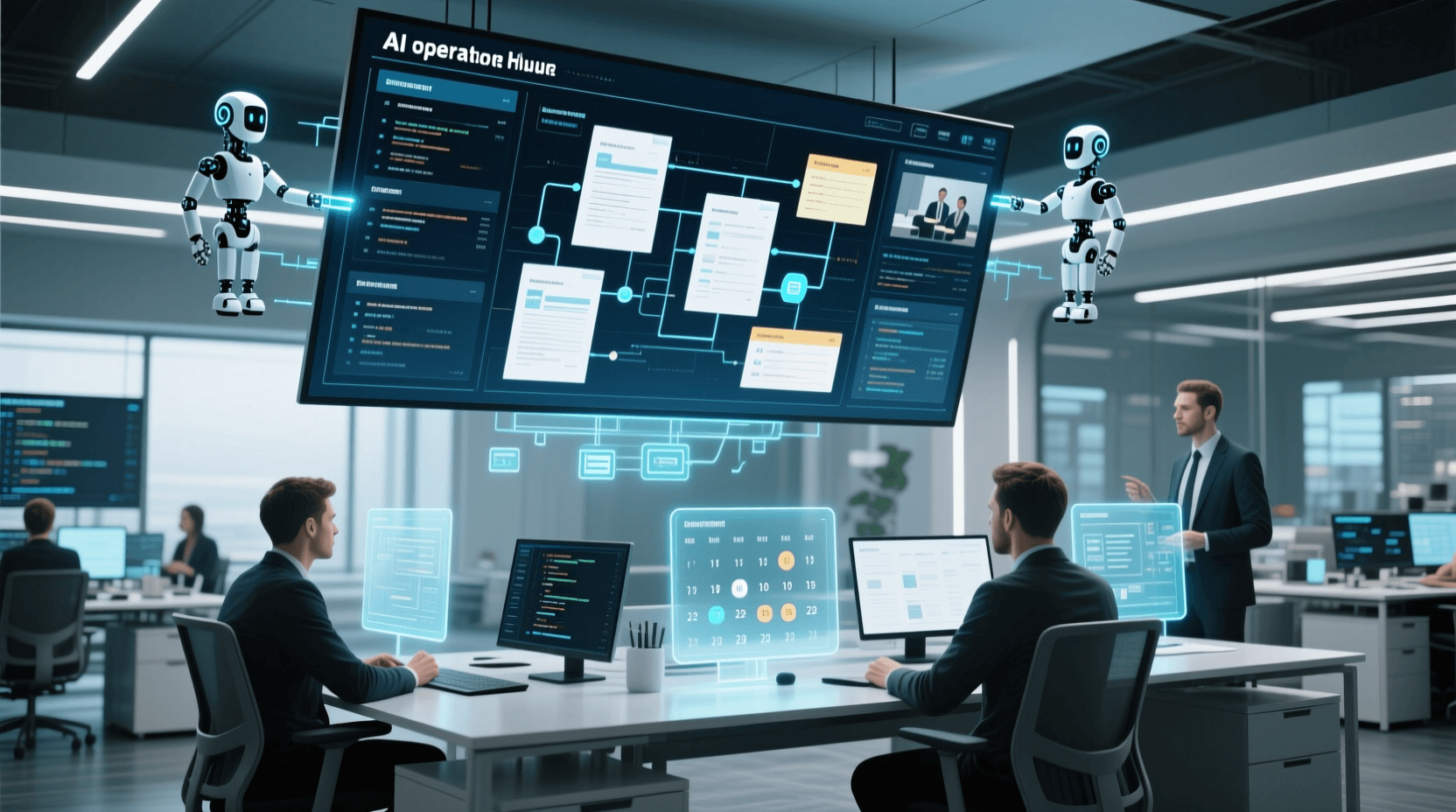
The next phase of workplace AI won’t be won by whichever app adds the smartest chatbot. It will be won by the platform that becomes the control layer for agents, data, and decisions.
That’s why the latest move from productivity platforms matters. We’re watching the office suite evolve into something closer to an operating system for AI work: a place where humans, software, and autonomous agents all interact around the same projects, documents, and workflows.
For users, this sounds convenient. For developers, it signals a much bigger shift: the interface is no longer the product. The orchestration layer is.
The workspace is becoming the agent’s natural habitat
For years, productivity tools were designed around human inputs: write a doc, update a database, assign a task, leave a comment. AI first entered these tools as a helper sitting off to the side, usually in the form of a chat box or autocomplete.
That model is already starting to feel limited.
Agents are more useful when they can act inside context rather than merely talk about it. A workspace already contains project specs, meeting notes, task dependencies, customer records, and operating procedures. That makes it a far better environment for AI execution than a blank prompt window.
This is where tools like HyNote AI fit naturally into the new stack. If meetings are being captured, transcribed, and summarized in real time, that content stops being passive documentation and becomes live operational input for downstream agents. Decisions made in a call can feed task creation, status updates, follow-up drafts, and internal knowledge retrieval without requiring someone to manually shuttle information between systems.
In other words, the note is no longer the end product. It becomes fuel.
Why developers should care: distribution is shifting upstream
There’s a major platform implication here. If workspaces become the place where agents are discovered, connected, and activated, then developers may need to rethink where distribution happens.
Historically, AI tool builders focused on standalone apps: get users to sign up, build loyalty, and become a daily destination. But if users increasingly expect AI capabilities to appear inside the tools where work already happens, then the standalone app risks becoming invisible infrastructure.
That doesn’t mean independent AI products lose value. It means they need to become more composable.
A marketplace model is especially well positioned in this environment. Agensi, for example, points toward a future where agent capabilities are packaged as skills rather than monolithic software experiences. That matters because teams don’t necessarily want one giant AI tool. They want a reliable way to add a specific capability—research, coding, automation, reporting, QA—to the agents they already use.
The winners may be the companies that make agent functionality portable across ecosystems, not just powerful within one branded interface.
The hidden challenge is trust, not intelligence
There’s a tendency to frame agentic software as a reasoning problem: can the model plan, use tools, and complete multistep tasks? But in business settings, the harder question is whether teams trust the agent enough to let it operate with minimal supervision.
That’s where many flashy demos break down.
An enterprise doesn’t just need an agent that can do things. It needs one that behaves predictably, respects permissions, leaves an audit trail, and fails gracefully. If a workspace becomes an execution environment for agents, then governance suddenly becomes a product feature, not a legal afterthought.
This is why operational reliability may become a stronger differentiator than raw model quality. SureThing.io speaks directly to that emerging demand: businesses want AI agents they can trust to run stable and unsupervised. As more companies experiment with embedded agents inside their workflows, “mostly works” will not be enough. Stability is what turns AI from a novelty into labor.
Expect the rise of the AI middle manager
One underappreciated outcome of this shift is the emergence of a new software role: the AI middle manager.
Not a single assistant, but a coordinating layer that routes tasks between specialized agents, humans, and business systems. One agent may pull insights from meeting transcripts. Another may update project databases. Another may generate customer-facing deliverables. The workspace becomes the shared environment where these actions are visible, reviewable, and linked to actual outcomes.
That’s a more durable vision than the “one super-agent does everything” fantasy.
In practice, teams will likely prefer a network of constrained, purpose-built agents over one highly autonomous system with broad permissions. This is better for security, easier to debug, and more aligned with how organizations already divide responsibility.
What AI tool users should do next
For teams adopting AI, the key question is no longer “Which chatbot should we use?” It’s “Where should agent work live?”
If your documents, meetings, projects, and knowledge base are fragmented, your agents will be fragmented too. Before adding more AI, companies should map their operational context: where decisions are made, where data lives, and where actions need to happen.
For developers, the message is just as clear. Build for embedded use, permission-aware automation, and cross-platform portability. The future AI stack will reward tools that can plug into the workspace layer cleanly and prove they can operate safely within it.
The big opportunity isn’t just making software that answers questions. It’s making software that can join the workflow, understand context, and take accountable action.
That’s when the workspace stops being a place where work is recorded after the fact—and becomes the place where AI work actually happens.