Why Voice-First AI Stacks Are Becoming the Next Big Developer Advantage
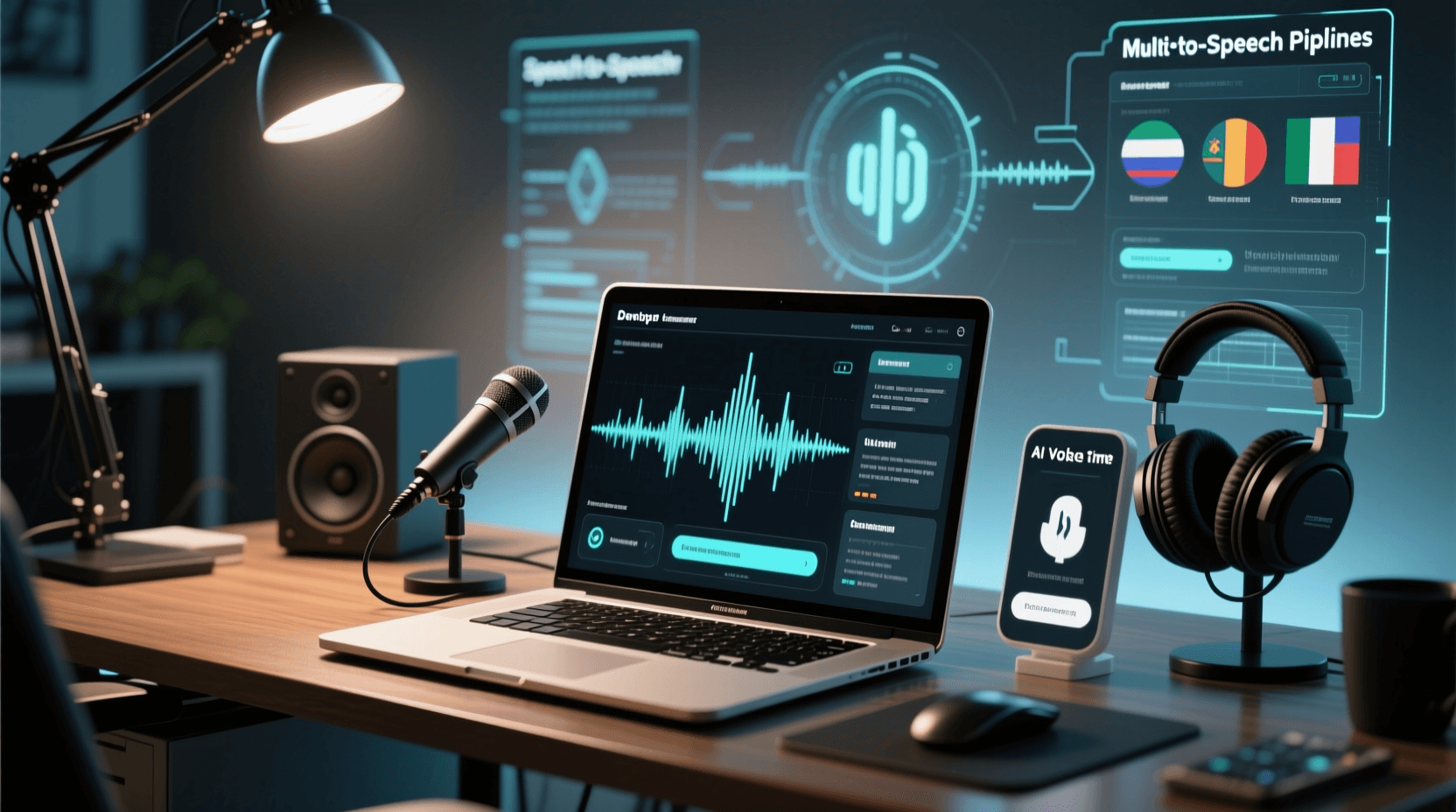
Voice AI is moving out of the demo phase and into product infrastructure. That is the real takeaway from the growing attention around end-to-end voice workflows: not that speech recognition is getting better, but that developers can now start treating voice as a native application layer instead of a bolt-on feature.
For years, teams approached voice in fragments. One service handled transcription. Another generated speech. A separate workflow tried to preserve speaker identity, latency, or conversational context. The result was usually brittle, expensive, or too slow for anything beyond basic dictation and chatbot readouts.
What is changing now is the emergence of integrated pipelines that combine speaker-aware ASR, low-latency text-to-speech, and speech-to-speech interaction in a way that feels programmable. That matters because once voice becomes composable, it stops being a novelty and starts becoming a serious product surface.
The new voice stack is about interaction, not transcription
Developers often underestimate how much product value lives between input and output. Speech recognition alone is useful, but it is not enough to create a compelling voice experience. The hard part is preserving context, distinguishing speakers, responding quickly, and generating output that sounds appropriate for the moment.
That is why speaker-aware ASR is especially important. In a meeting assistant, customer support recorder, multiplayer game, or community moderation tool, "who said what" is as important as the words themselves. Without speaker separation, transcripts become harder to search, summarize, act on, and trust.
The same goes for real-time TTS. If voice output arrives too late, users stop perceiving it as conversational and start treating it as a delayed system message. Latency is not just a technical metric; it defines whether an experience feels alive.
Speech-to-speech pipelines push this even further. They open the door to AI agents that can listen, reason, and respond in a continuous loop. That has implications far beyond virtual assistants. Think onboarding guides, language tutors, game NPCs, accessibility layers, live community bots, and internal enterprise copilots.
Why this matters for AI builders right now
The biggest shift is that voice is becoming accessible to smaller teams. You no longer need a specialized speech lab to experiment with production-grade workflows. If a capable developer can prototype voice systems in a notebook environment and connect them to APIs, then startups and indie builders suddenly have room to compete.
That lowers the barrier for a new category of products: voice-native micro-SaaS, AI companions, creator tools, and community automation platforms. We are likely to see a wave of "vibe built" products where founders move quickly from concept to working prototype, then validate with users before investing in custom infrastructure.
That trend fits naturally with marketplaces like Vibe Coded, where AI-assisted apps, games, and websites can be discovered, bought, and sold. As voice components become easier to assemble, more founders will package niche voice-first products for resale or rapid iteration. The market for lightweight but functional AI software is likely to expand, especially when the UX feels more human than text-only interfaces.
Voice UX is about capture speed as much as model quality
A lot of discussion around speech AI focuses on model benchmarks. In practice, user adoption often depends on something simpler: is speaking faster and easier than typing?
That is where tools like WriteVoice point to a broader reality. If users can reliably turn speech into text across many languages with high accuracy, they begin to expect voice input everywhere. Once that expectation is set, developers who still design only for keyboard-first workflows may feel increasingly outdated.
This is especially relevant for mobile apps, field operations, sales notes, creator workflows, and multilingual teams. Voice capture reduces friction. Friction reduction increases usage. Increased usage creates more training signals, more engagement, and more opportunities for intelligent automation.
In other words, the value of modern voice AI is not just that it sounds impressive. It changes product behavior.
Community bots and live environments are a major opportunity
One of the most underexplored areas for voice pipelines is real-time digital communities. Discord servers, gaming communities, live learning groups, and fan spaces are full of voice activity that remains largely unstructured.
Imagine what happens when voice-aware AI becomes easy to deploy in those environments. Bots could transcribe live discussions, identify speakers, summarize debates, generate follow-up actions, moderate harmful behavior, or convert spoken decisions into searchable knowledge.
That is why no-code bot platforms like VibeBot are worth watching. As voice models improve, the line between chat bot and voice agent will blur. The easiest products to adopt may not be the most technically advanced ones, but the ones that let communities activate useful voice intelligence without hiring an ML team.
The next competitive edge is orchestration
The winners in voice AI may not be the companies with the single best model. They may be the builders who best orchestrate multiple capabilities into a coherent experience.
That means handling turn-taking, context windows, speaker identity, fallback logic, compliance, and cost control. It also means designing products that know when to use voice and when not to. Not every workflow needs speech. But the workflows that do need it increasingly need it deeply integrated.
For developers, this is the moment to stop thinking of voice as a plugin. Treat it like a product primitive. For AI tool users, expect more software to listen, speak, and respond with context in real time.
The companies that embrace that shift early will not just ship cooler demos. They will build interfaces that feel fundamentally more natural than the text boxes we have been tolerating for the last decade.