Why Self-Evolving Agent Models Could Reshape the Open AI Stack
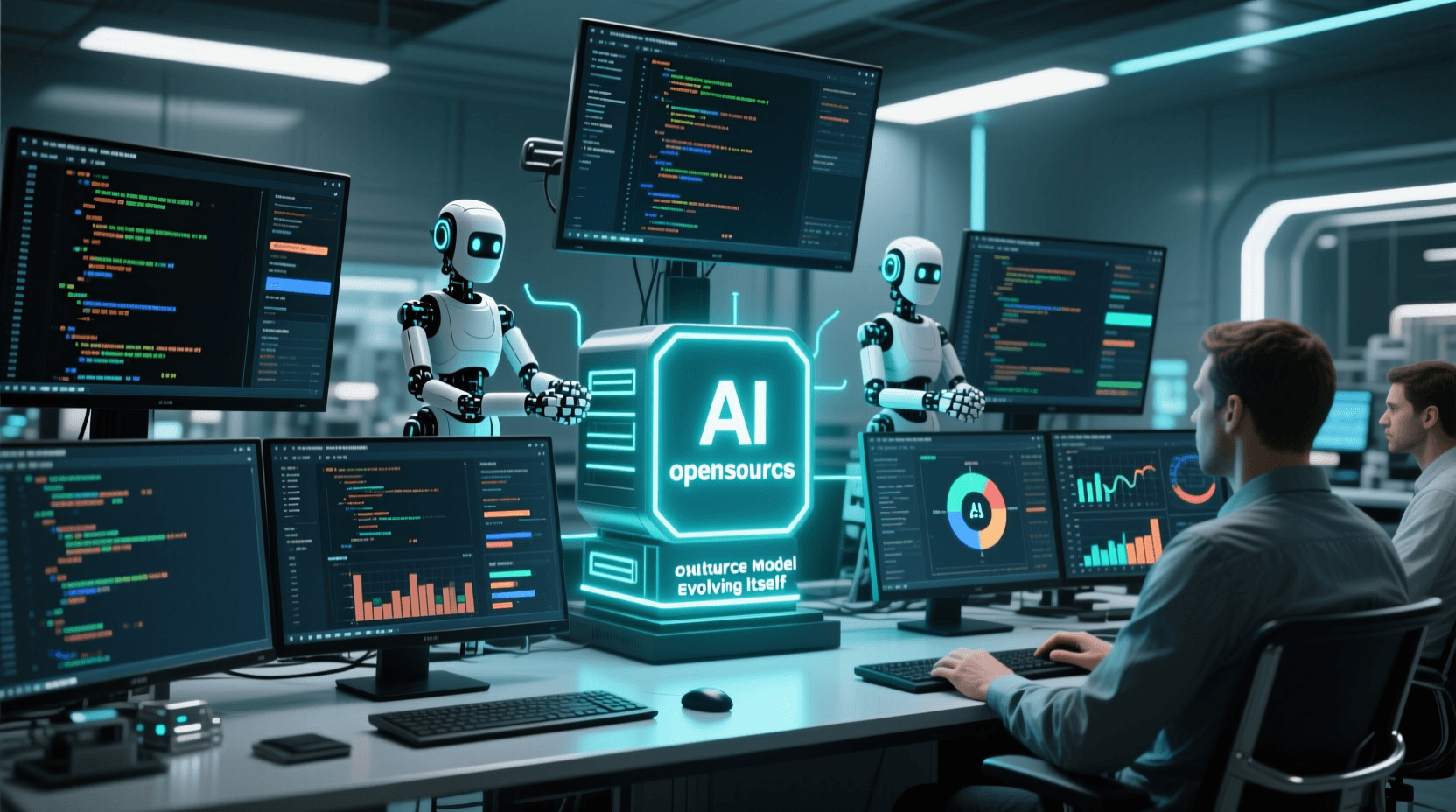
MiniMax’s latest open release matters for a reason that goes beyond benchmark scores: it signals a change in what developers should expect from foundation models. We are moving from models that merely answer prompts to models designed to participate in extended software workflows, evaluate their own outputs, and improve the systems around them.
That shift is especially important for builders of coding agents, terminal agents, and long-running autonomous systems. A model that performs well in agentic environments is not just “smarter” in the abstract. It is often better at handling the messy realities of real work: partial information, multi-step planning, tool failures, retries, memory, and the need to recover from mistakes without a human stepping in every few minutes.
The real story is not the benchmark, it’s the feedback loop
The most interesting part of this release is the idea of a model participating in its own development cycle. Whether that phrase is interpreted conservatively or ambitiously, it points toward a future where model training and deployment are increasingly intertwined with agent workflows.
In practical terms, that means developers should start thinking less about static model selection and more about adaptive systems design. The winning stack may not be “pick the highest-scoring model and ship it.” Instead, it may be:
- a capable base model
- a strong memory layer
- evaluation loops
- tool-use scaffolding
- automated debugging and refinement
This is where open-source momentum becomes strategically important. When weights are public, teams can do more than inference. They can fine-tune, inspect behavior, build specialized orchestration, and optimize for their own environments. That matters if you are building internal developer tools, autonomous issue triage, code migration systems, or ops agents that need to live inside your infrastructure rather than someone else’s API boundary.
Open-source agents are becoming systems, not chatbots
For AI tool users, the takeaway is simple: expect better software agents, not just better conversations. The next wave of value will come from models that can persist on tasks, coordinate tools, and maintain state across sessions.
That makes memory a first-class concern. A self-improving or self-correcting agent is only as useful as its ability to remember what happened, what failed, and what constraints matter. This is why tools like MemMachine are increasingly central to serious agent design. If an agent can code, test, and iterate but cannot reliably retain context across a long-running workflow, its apparent intelligence collapses under real-world conditions.
Developers building on open models should pay close attention to this. Benchmarks in software engineering and terminal environments are useful signals, but production reliability usually depends on the glue code: memory, retrieval, state management, and observability. The model gets the headline; the infrastructure determines whether users trust the result.
Self-evolving agents will raise the bar for orchestration frameworks
As models become more agent-native, orchestration frameworks will need to evolve too. It won’t be enough to chain prompts together and call it an autonomous system. Developers will need frameworks that support iterative planning, execution traces, rollback strategies, and dynamic policy updates.
That is exactly why projects like EvoAgentX feel well-timed. A self-evolving ecosystem of agents is not just a research curiosity anymore; it is becoming a practical design pattern. As open models improve, the competitive edge may shift from raw model quality to how well your agent framework can coordinate specialization, adaptation, and continuous improvement.
This also changes the economics of AI development. If open models can increasingly handle coding and terminal tasks at a high level, startups and enterprise teams get more leverage from their engineering talent. Instead of spending all their energy on prompt tuning around closed systems, they can invest in durable internal capabilities: custom evaluators, domain-specific fine-tunes, and agent architectures tailored to their workflows.
Closed models still matter, but the comparison is changing
None of this means proprietary APIs are suddenly obsolete. In fact, many teams will continue to pair open models with frontier hosted models for specific tasks. A model like GPT-4.1 remains highly relevant for coding, instruction fidelity, and long-context work, especially when teams need dependable API access and broad general performance.
But the comparison is no longer just open versus closed on raw intelligence. It is increasingly about control versus convenience, customization versus turnkey access, and ecosystem flexibility versus managed reliability.
For some teams, the best architecture will be hybrid: use an open model for agent loops that require local control and iterative experimentation, while reserving premium API models for high-stakes reasoning or fallback validation. That approach can reduce cost, improve privacy, and still preserve access to top-tier performance where it matters most.
What developers should do next
This release is a signal to revisit your assumptions. If you are building AI products in 2026, ask:
- Is your architecture designed for multi-step agent behavior or just single-turn responses?
- Do you have persistent memory for long-running tasks?
- Can your system evaluate and improve itself over time?
- Are you overpaying for API-only workflows that could be handled by open models?
- Do you have the orchestration layer needed to turn model capability into product reliability?
The broader lesson is that model progress is starting to favor builders who think in loops, not prompts. Self-evolving agents are not just a new model category; they represent a new expectation for how AI systems should operate. The teams that win will be the ones that combine capable models with memory, orchestration, and feedback mechanisms that let those models actually learn from work.
That is where the open AI stack gets interesting. Not when a model posts a strong score, but when developers can turn that score into a system that keeps getting better after deployment.